Gather a few things See what you’ll need
- A notebook or plain paper
- A pen
- A familiar place you can observe comfortably
Choose an exercise 4 things to try as you read
Choose a moment with edges
Choose a slice of time: waiting for the kettle, crossing a lobby or standing at the checkout. “From joining the queue to reaching the till” gives the scene edges.
A community discussion suggests noticing coffee, weather and sensory details on routine days. Andrea Stolpe’s Berklee teaching uses places and objects for specific language. This journal adaptation follows description with personal reflection.
Compare the optionsMove from a sound to a reflection
Move from a sound to a reflection
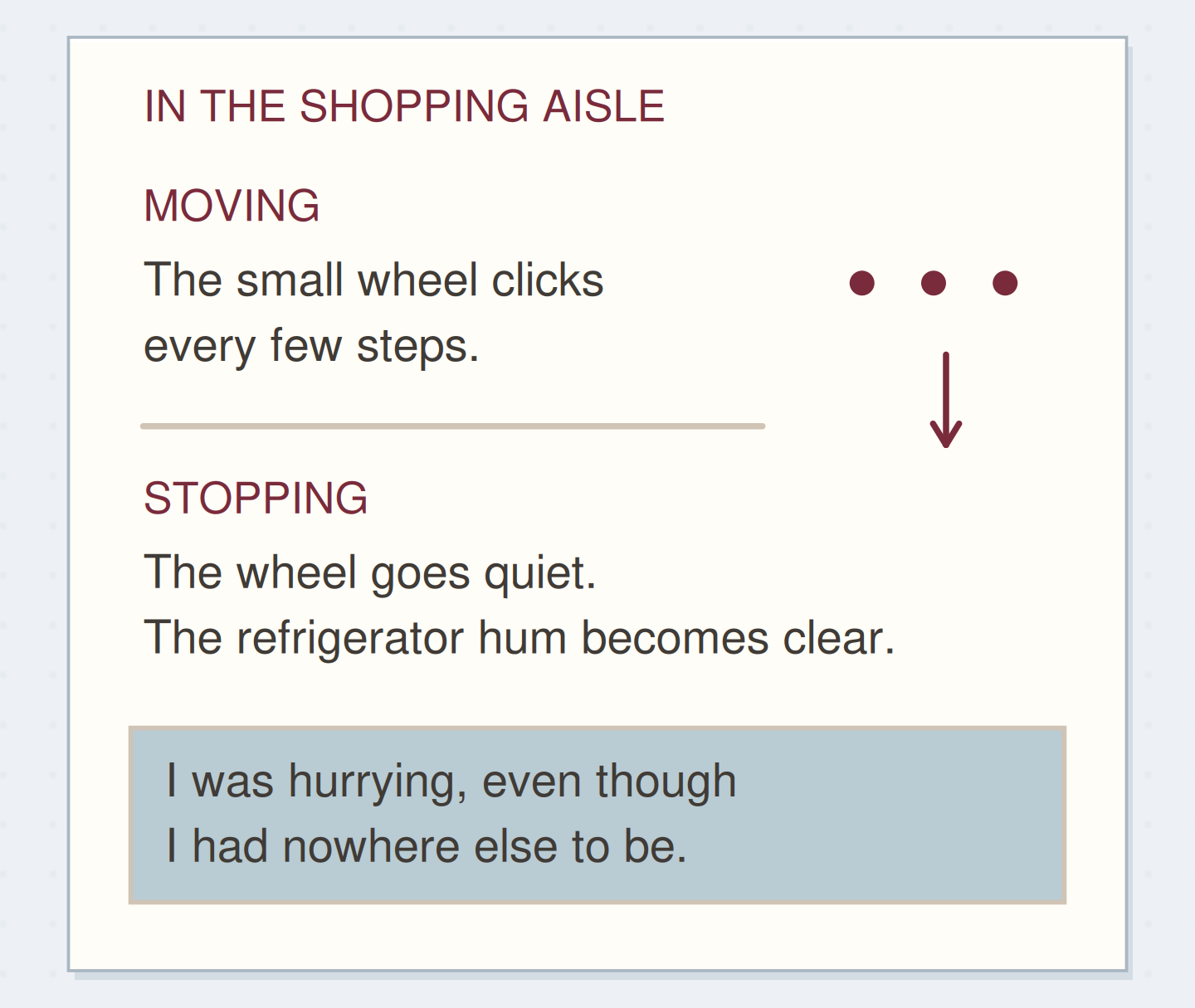
The cart example changes when the writer notices a contrast in sound.
Read the words in this example
- MOVEMENT
- The small wheel clicked.
- DETAIL
- Every few steps.
The moving cart gives the scene a specific sound.
Begin with what the writer could hear.
ONE WORKED EXAMPLE
The kettle goes quiet
You are writing about the few minutes spent waiting for a kettle in the kitchen. You noticed its sound and the light moving across the table.
Before
The first line says “a peaceful morning,” but the page gives no detail that would let you recognize this particular pause.
After
The entry says, “The kettle clicked off, and the room sounded much larger without the boiling. A bright strip crossed the table beside the cup. I stayed there long enough to watch it move before taking the tea upstairs.”
What changed—and what to check
Sound, light and a small action locate the pause. The final sentence supplies the writer’s response without asking the moment to explain a whole way of life.
Try this check. Find one change in the scene and check that the final sentence connects to something already described.
Use the senses available to you
Use two details you can notice or reliably remember—both may be sounds. There’s no five-sense checklist. Leave unavailable details out.
Start with a noun and something it does: “wheel rattles,” “bag knocks my knee,” or “handle feels cold.” Add an adjective when it distinguishes this moment. If a photograph later supplies the trolley’s color, label that as a detail checked in the photo rather than something you remembered while writing.
“Two sounds and a change in motion lead to a choice about pace.”
Let description arrive before explanation
Describe what moves, repeats or changes in two sentences. Then add “I noticed…” or “This mattered to me because…”
The connection can be modest: you were hurrying, recognized somewhere or enjoyed a pause. The Open University includes sensory observations as notebook material; the meaning you draw remains your own.
Write your versionWrite a scene and its connection
Write a scene and its connection
Keep the first two fields descriptive; use the last for your own meaning.
The cart wheel clicked every few steps.
When I stopped, I heard the refrigerator hum.
I had been hurrying even though I had nowhere else to be.
Your words have a place now.
You may use two details from the same sense. Do not invent one to complete a checklist.
- Words on this card
- 27
Read a complete ordinary entry
“The small wheel on the shopping cart clicked every few steps. When I stopped to compare two jars, the clicking stopped too, and I could hear the refrigerator hum. I realized I’d been pushing quickly even though I had nowhere else to be. For the next aisle, I let the cart set a slower rhythm.”
Two sounds and a change in motion lead to a choice about pace. The entry needs no larger claim about slowing down.
See the differenceReplace an adjective with evidence
Replace an adjective with evidence
Read the whole example before and after the change. The tinted lines show revised wording.
Tinted lines contain wording that differs between the two examples.
Before — Starting version
- SUMMARY
- The cart was noisy.
- LIMIT
- The kind of noise is missing.
After — Revised version
- ACTION
- One wheel clicked.
- RHYTHM
- A click every few steps.
Read the whole example before and after the change.
The adjective gives a general impression. The action and rhythm identify the sound.
GO A LITTLE FURTHERWhen the scene feels flat or overdecorated
When the scene feels flat or overdecorated
Replace a vague adjective with a comparison you mean: “loud enough to hear over the refrigerator.” If the prose feels ornate, return to action: “the wheel clicked” is clearer than “the cart’s iron song.”
If yesterday’s details will not return, keep the small part you do remember and say where the memory stops. Or begin a new, dated scene with a sound or page edge available now. A present observation can make a good entry without being placed inside yesterday’s moment.
GO A LITTLE FURTHERTry a closer view or a wider one
Try a closer view or a wider one
Move closer by following one change: a mug cools, light shifts or a sound stops. Move wider by adding the queue, doorway or kitchen table.
An absence works when you can place it: “The clock had stopped ticking” matters if you usually hear it there.
Try a what-ifThe photograph supplied a detail you did not remember
The photograph supplied a detail you did not remember
Use the clue while keeping its source visible.
You remember waiting at the bus stop. A later photograph shows a red coat, but you did not remember its color when you began the entry.
Compare the three choices
Which wording keeps the source of that detail clear?
- Write that the photograph shows the red coat, alongside what you remember
The visual clue can enrich the record without becoming an unaided memory. Keep sounds or smells separate unless you actually remember them.
- Fold the coat’s color into the remembered scene without a note
The color may be accurate, but this wording would hide how you recovered it. A brief photo label preserves that distinction.
- Add likely traffic sounds to match the photograph’s busy setting
Those sounds may be plausible, but the image does not establish them. Use a remembered sound or keep the account visual.
A later clue can join a memory when you say where it came from.
What would you try?
Choose an option to see what it would do. You can explore all three.
GO A LITTLE FURTHERStop when the detail has a connection
Stop when the detail has a connection
Can you locate the moment, notice a specific detail and see why you chose it? Then the entry can end.
Read the final connection beside the opening detail. If it reaches further than you meant, shorten it to what this moment actually showed you: a pause, a changed pace, a familiar sound. Keep that line, then leave the scene. The room can offer a different entry another day.
Something for a future page?
The Washi Tape ShopAffiliate links: we may earn a commission if you buy through these links.
Where this idea began
The method references explain the underlying ideas. Community links show the questions and experiences that helped shape this guide; they are not a popularity ranking. The worked examples here are our own.
- Community discussionDon’t know what to write in normal routine days when nothing special happens
Replies suggest ordinary moments, sensory descriptions and the writer’s current thoughts as material on uneventful days.
- Method referenceSongwriting Techniques Using Destination and Object Writing — Andrea Stolpe
Teaches using a destination or object to generate specific sensory language for writing.
- Method referenceWhy take notes and what to note — Open University
Suggests collecting sensory observations, overheard language, facts and scene or character notes in a writer’s notebook.