Gather a few things See what you’ll need
- A notebook page
- A pen
- An ordinary object already nearby
Choose something ordinary enough to describe
Pick an object within reach: a peg, spoon, key, folded cloth or empty cup. Choose something you can observe comfortably without handling it in a risky or awkward way. An object doesn’t need emotional significance before you begin; the writing may discover a connection, or it may remain a plain description.
Andrea Stolpe’s Berklee teaching describes object and destination writing as ways into specific sensory language, drawing on Pat Pattison’s object-writing practice. In a songwriting community discussion, a participant notes that forcing every sense into the exercise felt uncomfortable. This journal adaptation uses the details available to you and leaves the rest out.
Follow a peg into a present-day reflection
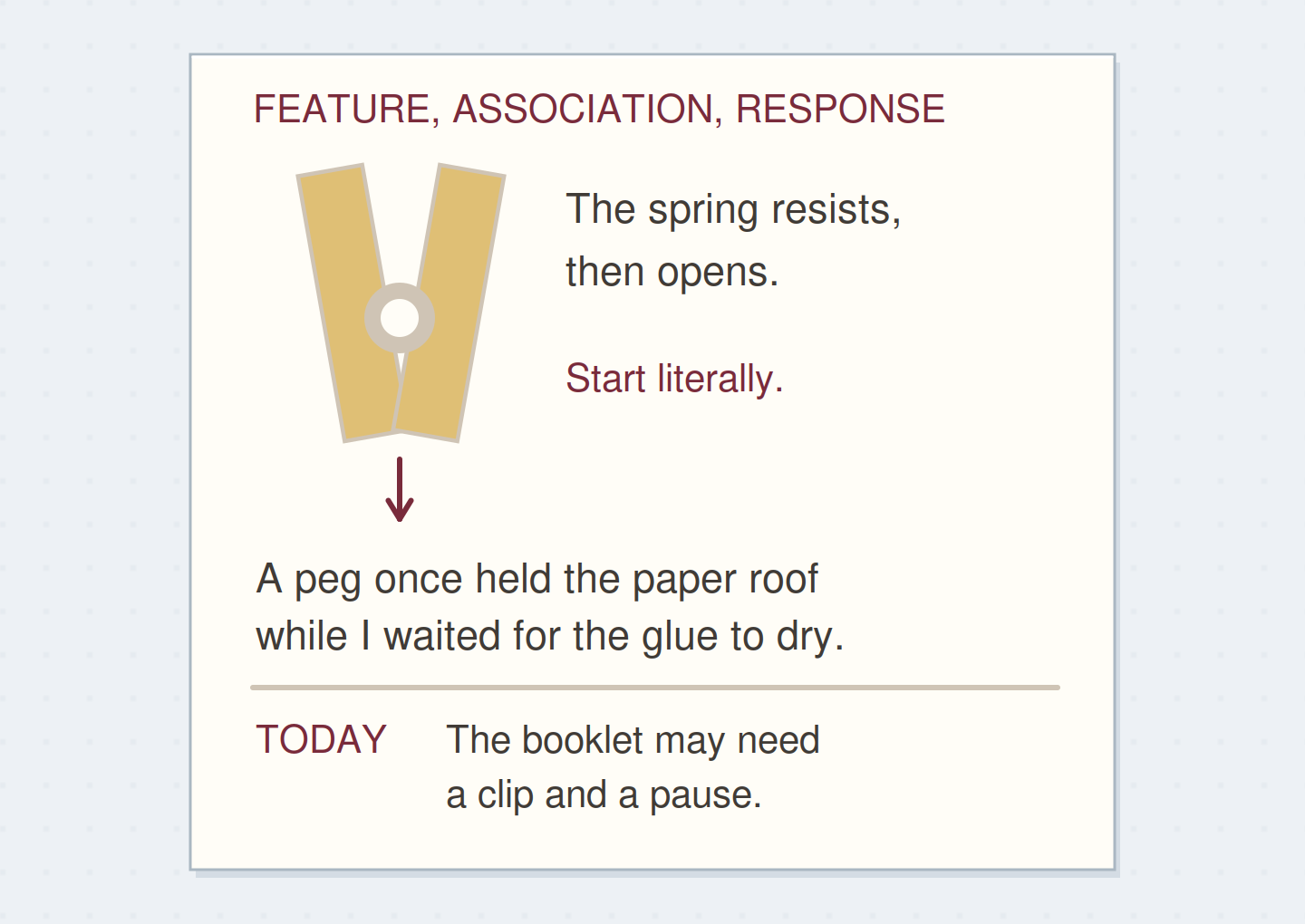
The example begins literally, follows an association and returns to today.
A physical detail gives the writing a starting point.
No symbolic meaning is assigned yet.
Describe a feature before reaching for a symbol
Write two or three short observations. “The peg’s wooden ends are pale.” “The spring is dark where my thumb rests.” “It opens with a small resistance.” Use what you can actually see, hear or feel; you don’t need to taste or smell an object just because a sensory list includes those categories.
Stay literal for the first few lines. If you immediately decide the peg represents perseverance, you may miss the more particular association waiting in its shape or action. A feature gives the writing something to return to. You can make a metaphor later, but it doesn’t have to arrive before the object itself does.
“The object opens the entry; your response gives it a direction.”
Follow one connection instead of every memory
Choose the feature that catches your attention and complete “This brings to mind…” The spring’s resistance might recall hanging washing with someone, fastening a paper model or keeping a bag closed. Follow the first connection you actually recognize rather than searching for the most meaningful one.
Write a short scene or thought from that connection. Then ask why it arrived today. The answer may concern something currently unfinished, a routine you miss or a preference you hadn’t named. If several associations appear, jot the others in a brief line and stay with one. The object is an opening, not an assignment to reconstruct every related memory.
Write feature, association and response
Use only details and connections you actually notice.
The peg’s spring resists my thumb, then opens.
Two pegs holding a paper roof while the glue dried.
The booklet may need a clip and an overnight pause.
Your words have a place now.
You may stop with a description if no association arrives.
- Words on this card
- 28
Follow the peg from detail to reflection
“The spring resists my thumb, then opens wider than I expect. I remember using two pegs to hold a paper roof while the glue dried. I kept checking whether it would stand without them. The roof stayed crooked, but the little house finally held.”
The writer adds, “I think I like temporary supports more than I admit. Today’s unfinished booklet probably needs a clip and an overnight pause, not another attempt to hold every layer at once.” The connection is the writer’s own, prompted by the peg. It doesn’t claim that pegs have a universal meaning or that every unfinished task needs the same solution.
Give a symbol a concrete starting point
The revision supplies a remembered scene instead of asking the object to mean everything.
Starting version
The symbolic claim is too broad to explain itself.
When the connection feels forced
Return to the object and add one more literal detail. “The wood has a shallow dent” gives you a fresh starting point if the first metaphor went nowhere. You can also write “No association yet” and keep the description as the whole entry. An object prompt doesn’t owe you a revelation.
If a metaphor becomes a string of grand claims, narrow it to the experience it actually recalls. “This key is my entire future” could become “The key reminds me of the first evening in this room.” You can still enjoy playful language, but let the specific connection carry the reflection rather than asking the symbol to explain everything.
Try function, wear or movement as a different route
An object’s function can prompt a question: what does it make possible? Wear can prompt a scene: where did that mark come from, if you know? Movement can prompt a description: how does it open, fold, roll or settle? Choose one route that fits the actual object.
You can repeat the exercise with the same object on another day. The detail you notice may stay the same while the association changes. Date the entries and let them differ. There’s no need to collect additional objects or preserve each one alongside the writing; the page holds the connection you chose to record.
Choose a route that fits the object
You do not have to complete a checklist of senses.
Ask what the object makes possible.
Stay close to an actual use.
Return to today before closing
Finish with “What this brings up today is…” and write one sentence in your own voice. It might be an observation, a question or a small practical idea. If the writing stays entirely in a remembered scene, that is fine too; just label the memory and let it have its own ending.
The object opens the entry; your response gives it a direction. Stop when you have a real feature and one connection you recognize, or a description you want to keep. Put the object back where it belongs. The finished work is the piece of writing, not a growing inventory of things you now have to save.
Where this idea began
Want to follow the idea further? These community discussions and maker references are a good place to start.
- Object Writing — Songwriting Technique from Pat Pattison
The post shares object-writing practice; a reply specifically describes feeling forced to include senses that did not fit their writing.
- Songwriting Techniques Using Destination and Object Writing — Andrea Stolpe
Teaches using a destination or object to generate specific sensory language for writing.