Gather a few things See what you’ll need
- A notebook page
- A pen
- Three short sentence openings
Choose an opening with room for your answer
Try one of these: “I noticed…”, “I wanted…”, or “I’m still wondering…” They ask for an observation, a preference and a question. Pick the one with a word already waiting behind it. You can write the stem exactly, shorten it or replace it with your own phrasing.
Kathleen Adams identifies sentence stems as a journal-writing technique. In a community conversation about not knowing what to write, a participant describes one sentence suggesting the next. Those ideas meet here: use an incomplete sentence as the first nudge, then allow your answer to supply the next subject.
Choose what the opening asks for
Three stems lead into the same lunch break from different directions.
An observation stem asks for something concrete.
Supply a detail before explaining it.
“A completed stem is a beginning, not a promise to fill the notebook.”
Complete once, then ask for a detail
Finish one stem in a single sentence. Read the answer and underline a concrete word or a vague one that needs explaining. Add “For example…” beneath it. Describe one scene, action or remembered phrase that makes the answer recognizable to your future self.
If “For example” doesn’t fit, try “I noticed this when…” or “By that, I mean…” The follow-up belongs to your answer, not to a prepared list. Two or three sentences may be enough. Once the writing begins to move, leave the stem behind and continue with whatever connection your own words have made.
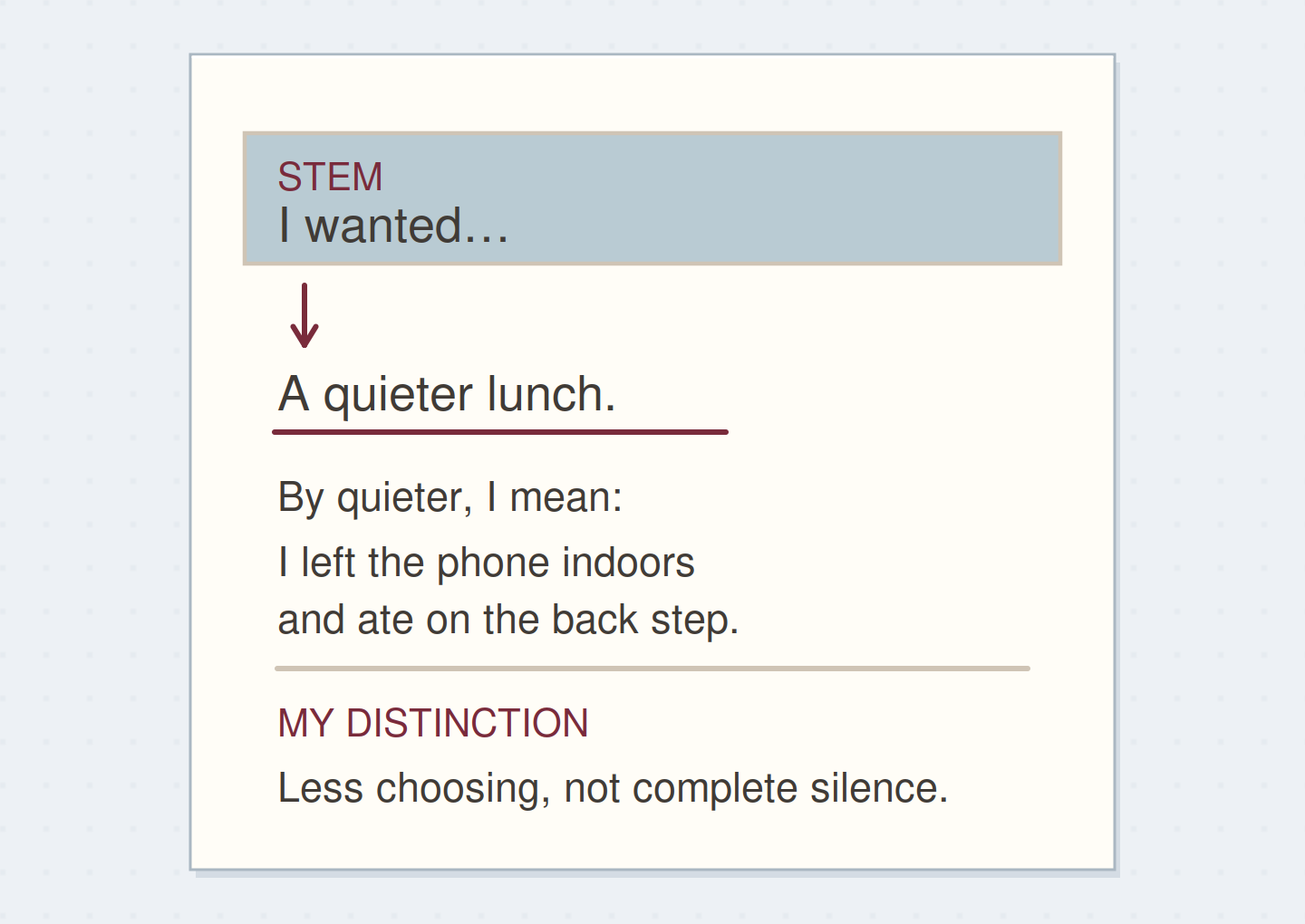
Complete, specify, continue
Replace the lunch example with one answer and a detail that belongs to it.
I wanted a quieter lunch.
I left the phone inside and ate on the back step.
It wasn’t silent; I wasn’t choosing what to listen to.
Your words have a place now.
After the detail, follow your own sentence rather than finding another prompt.
- Words on this card
- 26
Turn a vague answer into a small scene
The first answer might be “I wanted a quieter lunch.” That is a useful start, but it could describe many days. A follow-up makes it specific: “By quieter, I mean eating outside without choosing another video. I took my sandwich to the back step and heard someone practicing scales through an open window.”
The writer then adds, “It wasn’t silent; I just wasn’t deciding what to listen to.” Now the entry contains a distinction between silence and fewer choices. The stem did not prescribe that insight. It helped the writer reach a scene detailed enough to discover their own meaning in it.
Give a broad answer a visible action
The revised line is easier for the writer to recognize later.
Starting version
The first answer could fit almost any day.
Rescue an answer that sounds borrowed
If you write something that sounds like a greeting card, ask, “What would I say if I were explaining this to myself in the kitchen?” Replace abstract praise or criticism with ordinary language. “I embraced stillness” might become “I left the phone indoors while I ate.” The plain version is easier to recognize later.
If every opening produces “nothing,” change the scale. Complete “In the last hour, I noticed…” or “One thing within reach is…” You can also write that you don’t want to answer this stem. That response may show you which question would feel more useful, or simply mark where you want to stop.
Change what the stem asks you to notice
Observation stems invite details: “The sound I remember is…” Preference stems invite choices: “I would gladly repeat…” Question stems leave something open: “I can’t yet tell whether…” Keep the distinction clear so the menu offers different routes, not three versions of “How do I feel?”
For an ongoing project, make the openings specific to that work. “The part that surprised me was…” suits a cooking attempt; “The sentence I kept returning to was…” suits a reading entry. Don’t force every area of life into the same three questions just because the first set worked once.
Tune a stem to what you are doing
The opening can belong to the activity already in your day.
Ask about a surprising result.
The answer can be practical or descriptive.
Know when the prompt has done enough
Stop adding prompts once you have an answer with one recognizable detail. You may continue writing, but follow the material already on the page. A completed stem is a beginning, not a promise to fill the notebook. If the entry ends after four lines, its shape is still complete.
At the bottom, keep only a stem you actually want to reuse. You can discard the others without replacing them immediately. Over time, a small personal set can emerge from openings you’ve tried, rather than from a list of questions you feel you should eventually answer.
Where this idea began
Want to follow the idea further? These community discussions and maker references are a good place to start.
- What do you write about when you don’t know what to write about?
A reply suggests letting one sentence prompt the next and writing about feeling stuck rather than requiring a significant event.
- A Short Course in Journal Writing — Kathleen Adams
Defines sentence stems as unfinished openings completed by the journal writer.