Gather a few things See what you’ll need
- A journal or notes document
- A pen or keyboard
- One question you would like to revisit
Choose a question that invites particulars
Try “What held my attention today?” It can lead to a conversation, a practical problem, a sound or a page you read. A useful recurring question has enough range for different days but asks for something you can identify. “Was I my best self?” is harder to answer without turning the entry into a verdict.
A community writer describes using the same question about what differed from yesterday to find new details in similar days. Another thread repeats questions at notebook boundaries. Your version can use that continuity at a smaller scale, with a question chosen for your own interests rather than a prescribed daily theme.
Let one question meet three different days
Each answer to “What held my attention?” includes a particular detail.
A small flaw on a familiar object holds attention.
The answer includes what the writer did.
Give the question a limited first trial
Try answering on four occasions over the next couple of weeks. That number is only a convenient way to see whether the question has range; it isn’t a requirement for a meaningful series. Write the question once at the top of a page, then give each answer its own date.
You can also keep the entries on ordinary daily pages and add a short label so you can find them. Avoid pre-drawing thirty empty boxes if visible blanks make the exercise feel like unfinished homework. Leave enough space for the answers you actually write, and extend the series only when you want to.
“A repeated question can make room for different days.”
Answer from this day before reading the others
Write one answer and one detail. For “What held my attention?”, you might name the loose thread on a coat and explain that you spent the train ride deciding how to mend it. The detail gives the answer a particular shape; the category “clothes” would be too broad to compare usefully later.
Try answering before rereading the previous entry, so yesterday’s wording doesn’t automatically supply today’s response. If the answer really is the same, keep it and add the current context. Repetition may be accurate. The aim is to record what happened to draw your attention, not to prove that every day is novel.
Write today’s answer without forcing novelty
Use one answer, its particular detail and an optional later comparison.
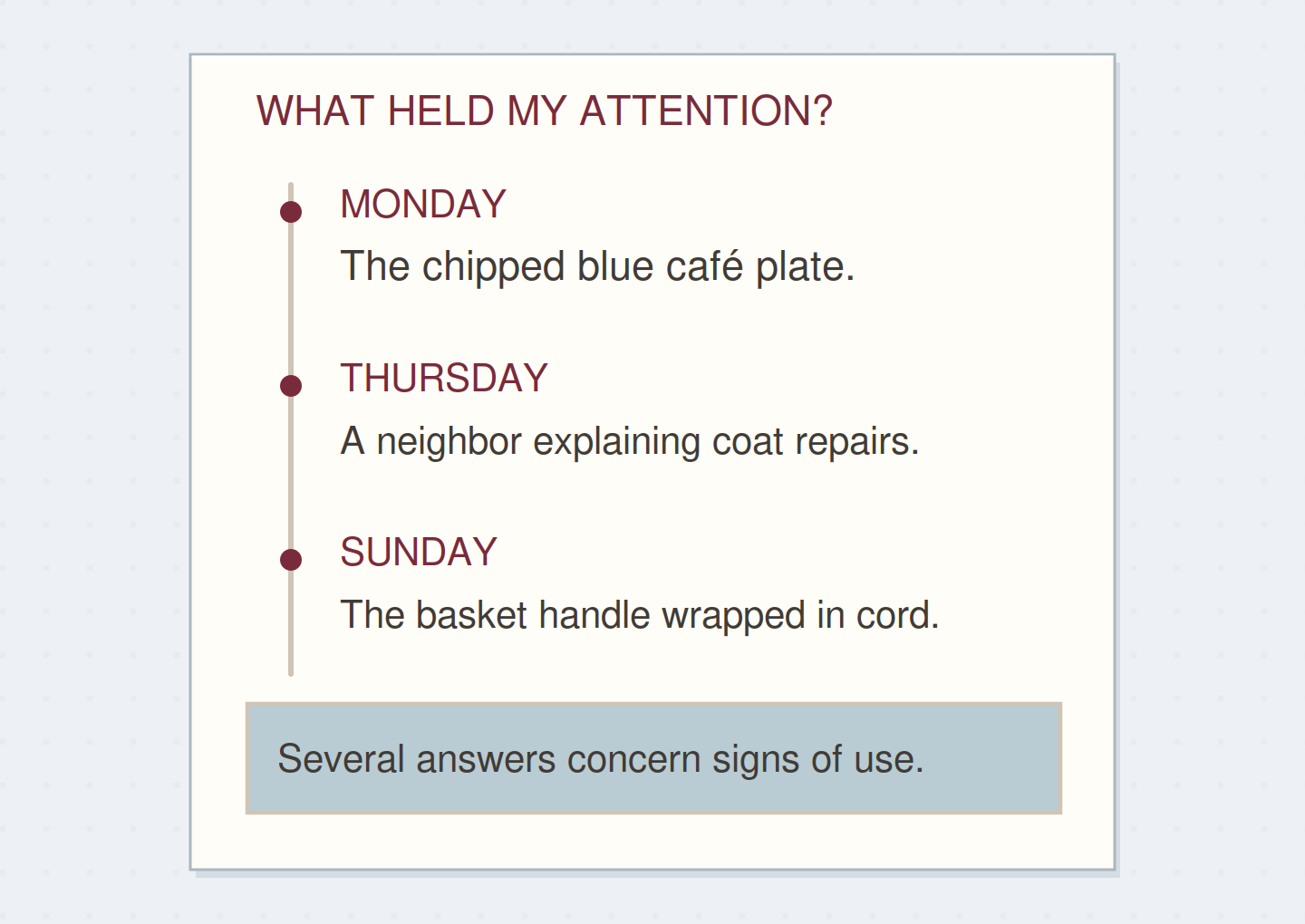
Monday — What held my attention?
The chipped blue plate. I turned it to find the smallest chip.
Several answers concern repairs and signs of use.
Your words have a place now.
The comparison belongs after you have several answers; it can stay tentative.
- Words on this card
- 26
Read three answers to one question
Monday: “The chipped blue plate at the café. I kept turning it to find the smallest chip.” Thursday: “A neighbor explaining how she repairs coat linings. I asked about the pocket seam.” Sunday: “The repaired handle on the market basket. Someone had wrapped it with a different-colored cord.”
The writer’s comparison is, “I’m noticing repairs and signs of use.” That statement stays close to the three entries. It doesn’t conclude that the writer has discovered a permanent identity or a hidden explanation for everything. The series offers a subject they might want to write about next: what makes a repair satisfying to notice.
Keep repetition specific
A repeated category can become a recognizable entry with one follow-up.
Starting version
The repeated category says little about this occasion.
When the answers keep repeating
Ask whether the repetition is real or whether the question has become too broad. “Work” every time may need a follow-up: “Which moment at work?” But the same specific concern on several dates can be worth preserving as it is. You don’t need to make a repeated answer look original.
If the question reliably leaves you blank, change it and mark the change. “What held my attention?” might become “What did I make time for?” Don’t mix the answers under an unchanged heading, because they now answer different questions. A visible change of prompt is part of how you find a series that suits you.
Read for a thread and an exception
After the short trial, read the answers together. Circle one recurring detail or category, then look for an answer that doesn’t fit. The exception helps keep your summary honest. If three entries concern repairs and one concerns birdsong, the series has room for both.
Write a comparison sentence using modest language: “Several answers mention…” or “This week, I noticed…” YearCompass’s question-led reflection is another example of giving a period a clear boundary. Here, that boundary keeps a small sample from turning into a sweeping claim about your habits or your future preferences.
Choose what happens to the series next
Continuation is one option among several.
The question still produces details you want.
Extend the series without promising a streak.
Keep, change or retire the question
Decide whether to use the same question again, alter it or stop the series. A question can be useful for a season and then become stale. You haven’t failed it by moving on. Keep the completed answers together or add a page reference from your next entry.
A repeated question can make room for different days. The stopping point is a short set of answers and one careful observation about them. If you miss an intended date, resume with the date you actually write. You don’t need to reconstruct missing answers before the next real one is allowed onto the page.
Where this idea began
Want to follow the idea further? These community discussions and maker references are a good place to start.
- I journal every day, usually four lines or so
The author describes returning to one question about what differed from yesterday to find specific material in similar days.
- A first and last page idea
The post proposes repeating the same questions at notebook boundaries to compare answers over time.
- YearCompass 2025–2026 — official booklet, pages 2 and 6–7
The official booklet separates past-year reflection from the year ahead on page 2 and uses bounded reflection questions on pages 6–7; these are the limited structural ideas referenced here.