Gather a few things See what you’ll need
- A current notebook page
- An older entry or a remembered reference point
- A pen
Choose two moments and one subject
Pick a current subject and an earlier reference point you can locate. An old entry is useful because it preserves wording from the time. If you’re working from memory, label the earlier account “Remembered now” and use an approximate date rather than pretending it is a contemporary record.
A journaling community post suggests repeating questions at notebook boundaries to compare answers. YearCompass also separates looking back from looking ahead in its reflection booklet. This smaller exercise borrows the value of a clear time boundary while focusing on one subject and two actual accounts, not a full review of a year.
See how context changes the comparison
The soup example becomes more accurate when both moments keep their conditions.
The old view concerns one dinner under specific conditions.
Keep the date and limitation together.
Give the earlier view its own context
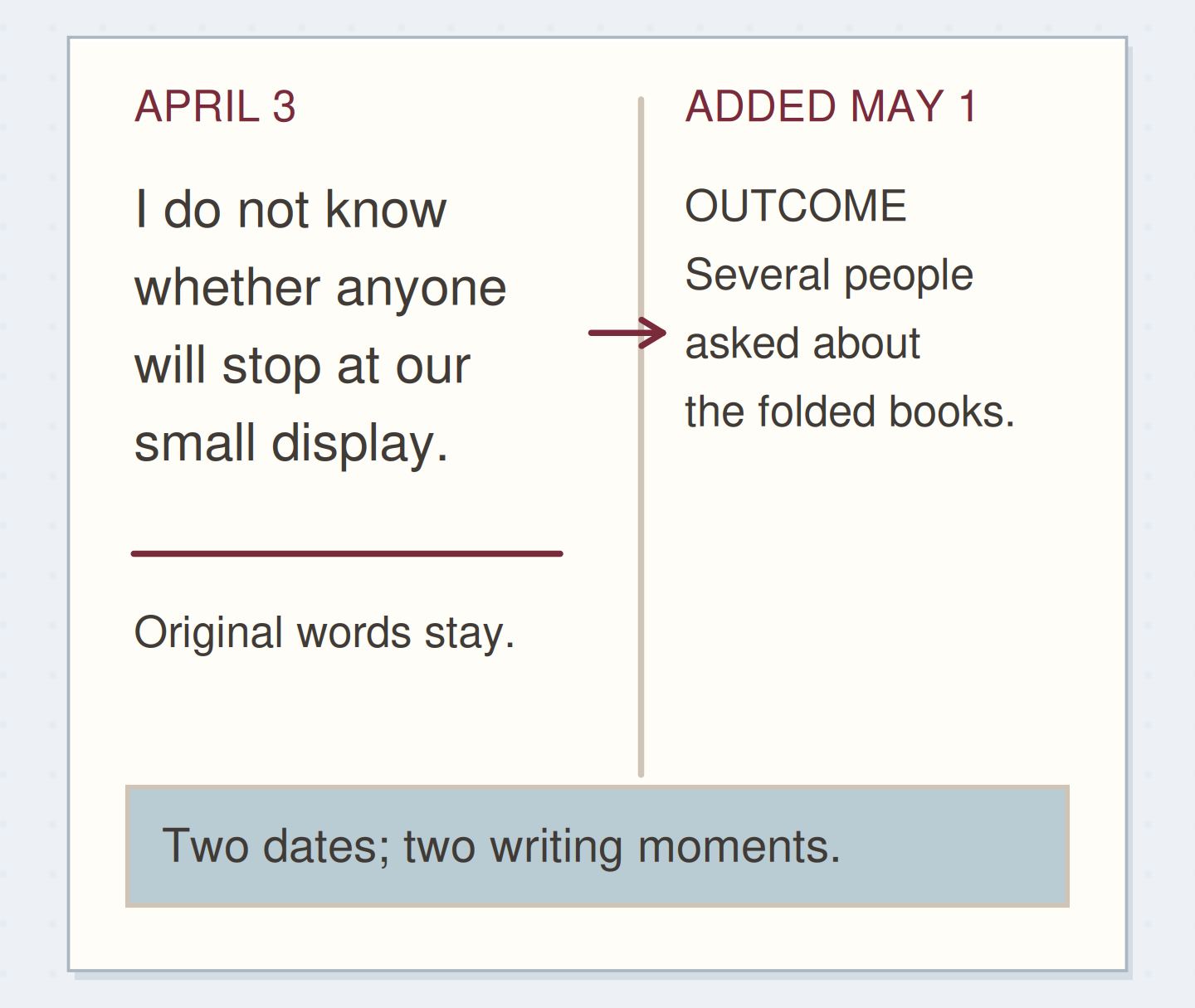
Copy one short sentence from your own older entry or summarize it faithfully. Add a line about the conditions around it. What did you know? What had you tried? What time, access or company did you have? These details help you read the earlier view as something written in a particular situation.
Avoid changing the old sentence to make the comparison neater. If it says “I might try,” don’t turn it into “I was determined.” If it says “I hated the first session,” leave that wording available. Your current preference doesn’t need a tidier origin story in order to be real.
“Your earlier self deserves context, not a score.”
Answer the same subject from today
Write a current sentence that responds to the subject, then give today’s context. Keep the scale comparable. An earlier line about one uncomfortable drawing class should be compared with your current experience of that activity, rather than with a broad claim that you now handle every unfamiliar situation well.
Look for one concrete difference and one thing that remains. “I know where the materials are” is a difference. “I still prefer sitting near the edge” is a continuity. Including both makes the entry more precise than a simple before-and-after transformation. It also leaves room for the parts of life that change unevenly.
Give both versions their context
Use a real old entry or label a remembered account honestly.
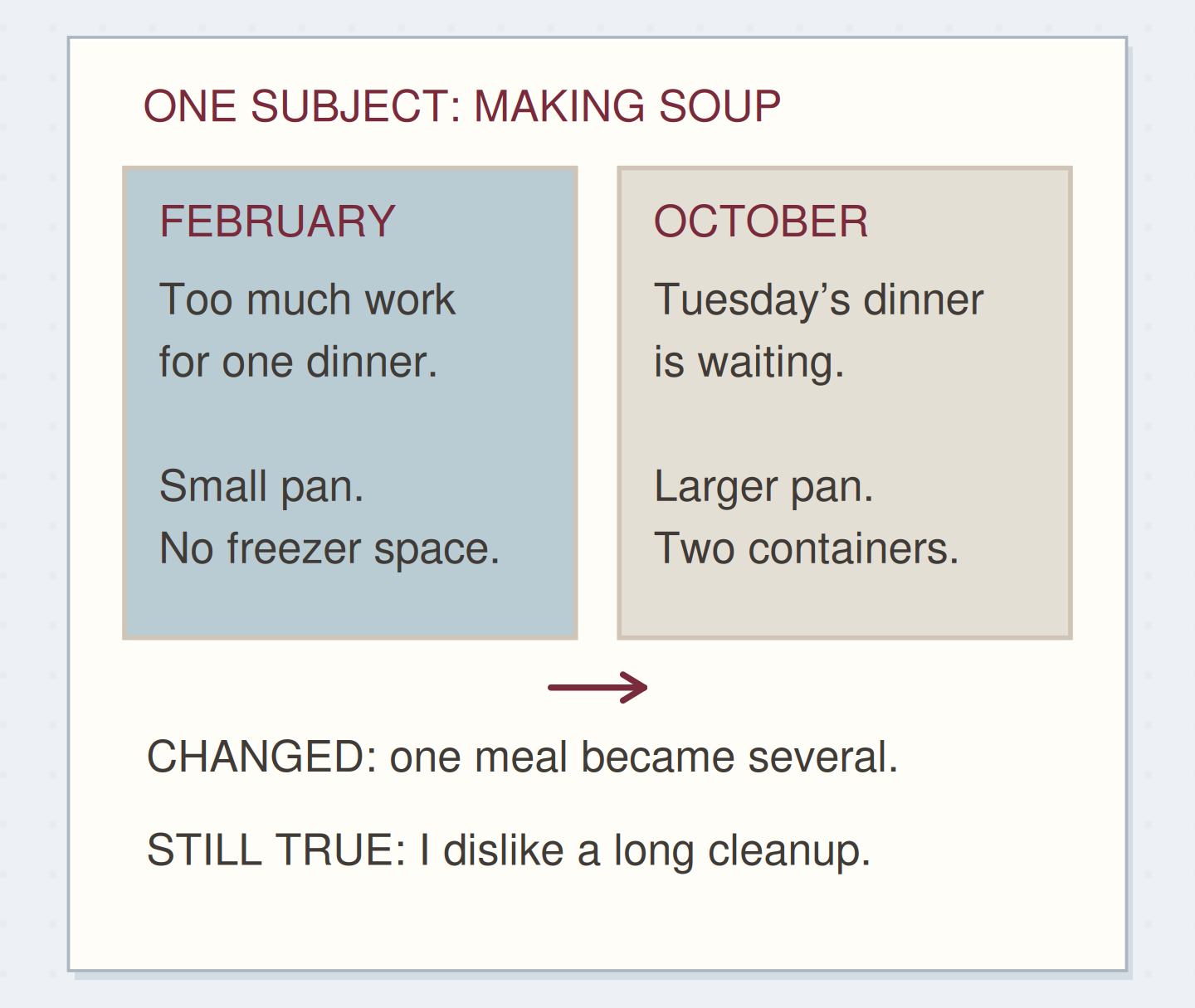
February: soup seemed too much work for one dinner; I had no freezer space.
October: I enjoy making several portions with two freezer containers available.
The practical setup changed my preference; I still dislike cleanup.
Your words have a place now.
If the earlier account is reconstructed, write “Remembered now” beside it.
- Words on this card
- 35
Try the soup-making example
Then, February: “Cooking a pot of soup feels like too much effort for one dinner.” Context: the writer had a small pan and no room in the freezer. Now, October: “I like making soup on Sunday because Tuesday’s dinner is already waiting.” Context: a larger pan and two available freezer containers.
The comparison line reads, “My opinion changed when the meal stopped being only one meal.” A continuity follows: “I still don’t enjoy a long cleanup.” This example records a change in preference alongside a change in circumstances. It doesn’t turn the earlier reluctance into a personal failing that the present writer has overcome.
Trade a progress verdict for a precise change
The revision describes the situation instead of ranking the writer.
Starting version
A verdict removes the earlier context.
When comparison starts sounding like a report card
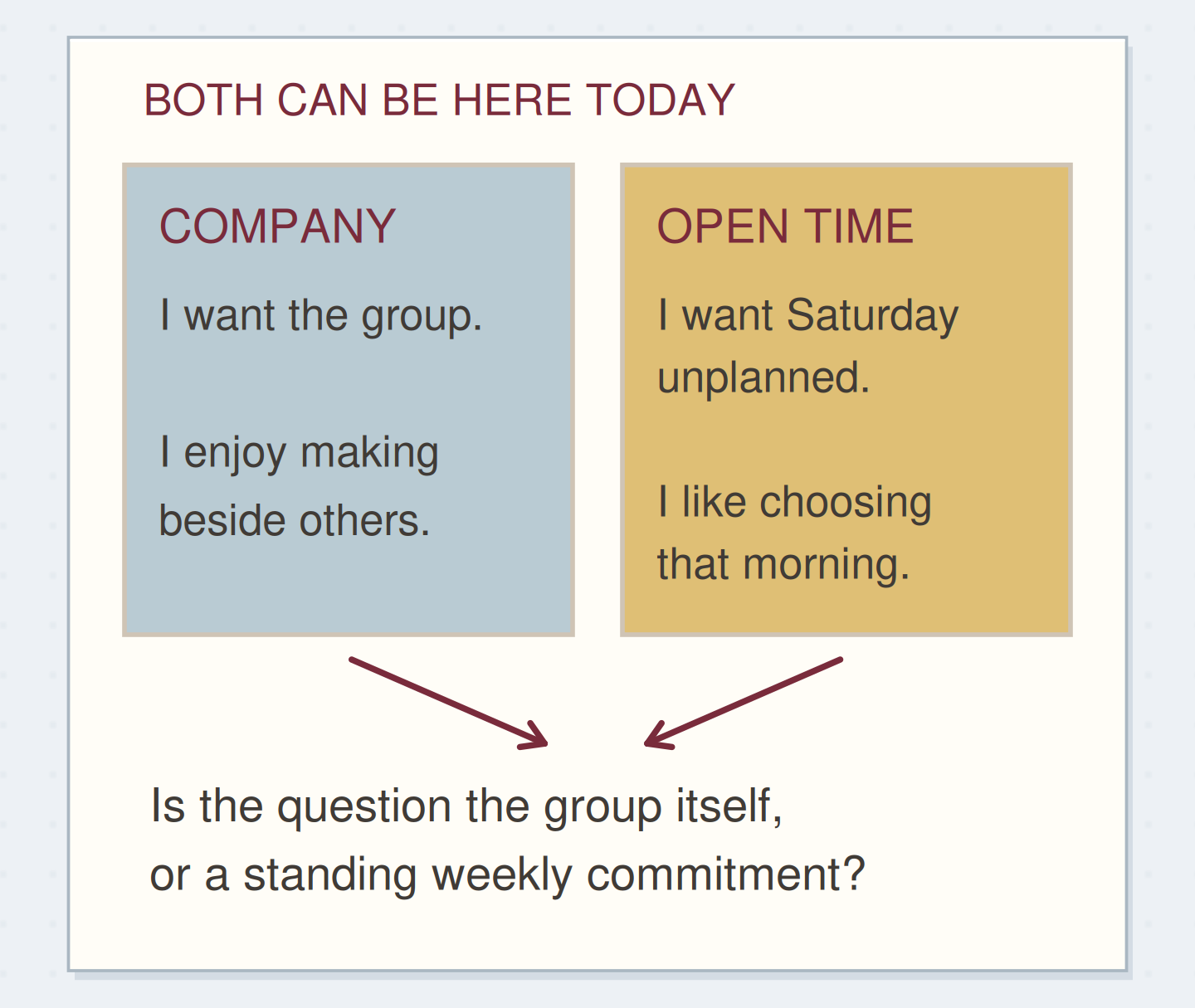
Replace “better” or “worse” with what actually changed. More frequent? Less enjoyable? Easier to begin? Different company? A specific description can hold mixed results. You may be more practiced at an activity and also less interested in it. Both observations can belong on the page.
If the old entry makes you want to explain away every sentence, narrow the exercise to one harmless detail or choose a different subject. Rereading is optional. You can compare two recent views, use a remembered routine or leave the page for another time. The exercise doesn’t require opening every part of an old notebook.
Let continuity be a complete finding
Sometimes the useful line is “I still want the same thing.” Give that continuity evidence: the same kind of afternoon, the same place you choose to sit or the same question you keep asking. Repetition can identify a durable preference without proving that it will last forever.
You can also record a return. “I liked this, stopped doing it, and like it again” has a different shape from steady change. Add the middle period if it matters to understanding the comparison, but keep the entry anchored to your chosen subject. A third date should clarify the account, not become an obligation to reconstruct every month.
Three valid shapes of a comparison
A then-and-now entry does not have to show improvement.
The preference or practice is different.
Name what changed rather than calling it progress.
End with one careful sentence
Finish “Across these two moments, I notice…” and name the difference, continuity or uncertainty you can support. If you want, add a question for a later entry. Choose a meaningful occasion to revisit it, such as finishing the current project, rather than scheduling a review simply to create another comparison.
Your earlier self deserves context, not a score. Stop when both moments have a date, a view and enough context to understand them. The finished page can preserve a modest shift accurately. It doesn’t need to tell a complete story about who you used to be or who you will become.
Where this idea began
Want to follow the idea further? These community discussions and maker references are a good place to start.
- A first and last page idea
The post proposes repeating the same questions at notebook boundaries to compare answers over time.
- Do you reread your journal entries some time after writing them?
A reply describes returning with a different pen color to answer an earlier entry or note how events turned out.
- YearCompass 2025–2026 — official booklet, pages 2 and 6–7
The official booklet separates past-year reflection from the year ahead on page 2 and uses bounded reflection questions on pages 6–7; these are the limited structural ideas referenced here.