Gather a few things See what you’ll need
- A notebook or notes document already in use
- A comfortable writing tool
- An optional bookmark or plain reentry note
Choose the amount before choosing the subject
Ask which form feels available: a few words, a short paragraph or no writing today. If you choose words, they can be fragments such as “rain at the doorway; warm leftovers; unfinished call.” If a paragraph feels possible, write it. There is no advantage in shrinking an entry that you actually want to continue.
A notebooks community writer describes overthinking or feeling tired before starting, while a few sentences like a note to a friend feel more natural. The practical response here is to reduce the decisions surrounding the entry. Choose the amount first so the blank page doesn’t silently ask for more than you meant to give.
Keep a short entry and a later return distinct
The gap does not become a backlog between two real entries.
The first note preserves one small action.
It is complete at its current size.
Begin with the date you are actually writing
After a gap, write today’s date and begin with what is present. You can mention the gap if you want to, but an apology or a recap is optional. If an event from the missing period matters now, write about that event when you choose it, using an approximate date if necessary.
In a community discussion about apologizing to a journal, participants describe exhaustion around catching up and alternatives such as resuming in the present. You don’t need to reconstruct every unwritten day. The notebook can hold a discontinuous record honestly, with the dates showing where entries exist and where they don’t.
“A small entry does not create a writing debt.”
Use a form that makes the next move obvious
For fragments, write three concrete phrases and stop. For a note, begin “Today, the thing I want to keep is…” For a question, write what you’re wondering without making yourself answer it. These are different forms, not levels you have to climb through before an entry counts.
If choosing among them is also work, keep one familiar default. It might be a single observation followed by “More another time, if I want.” George Mason University’s brainstorming guidance allows fragments, lists and questions while generating material. A personal journal can likewise use the form that lets your current words arrive without an editing project.
Write a small note with an optional way back
Use only the fields that help; a cue can remain blank.
September 4: she moved her bag so mine stayed dry.
I want to remember the small act during the rain.
Maybe write about the station wait.
Your words have a place now.
This note is complete without expansion. A later entry can begin somewhere else.
- Words on this card
- 26
Read a small entry and a later return
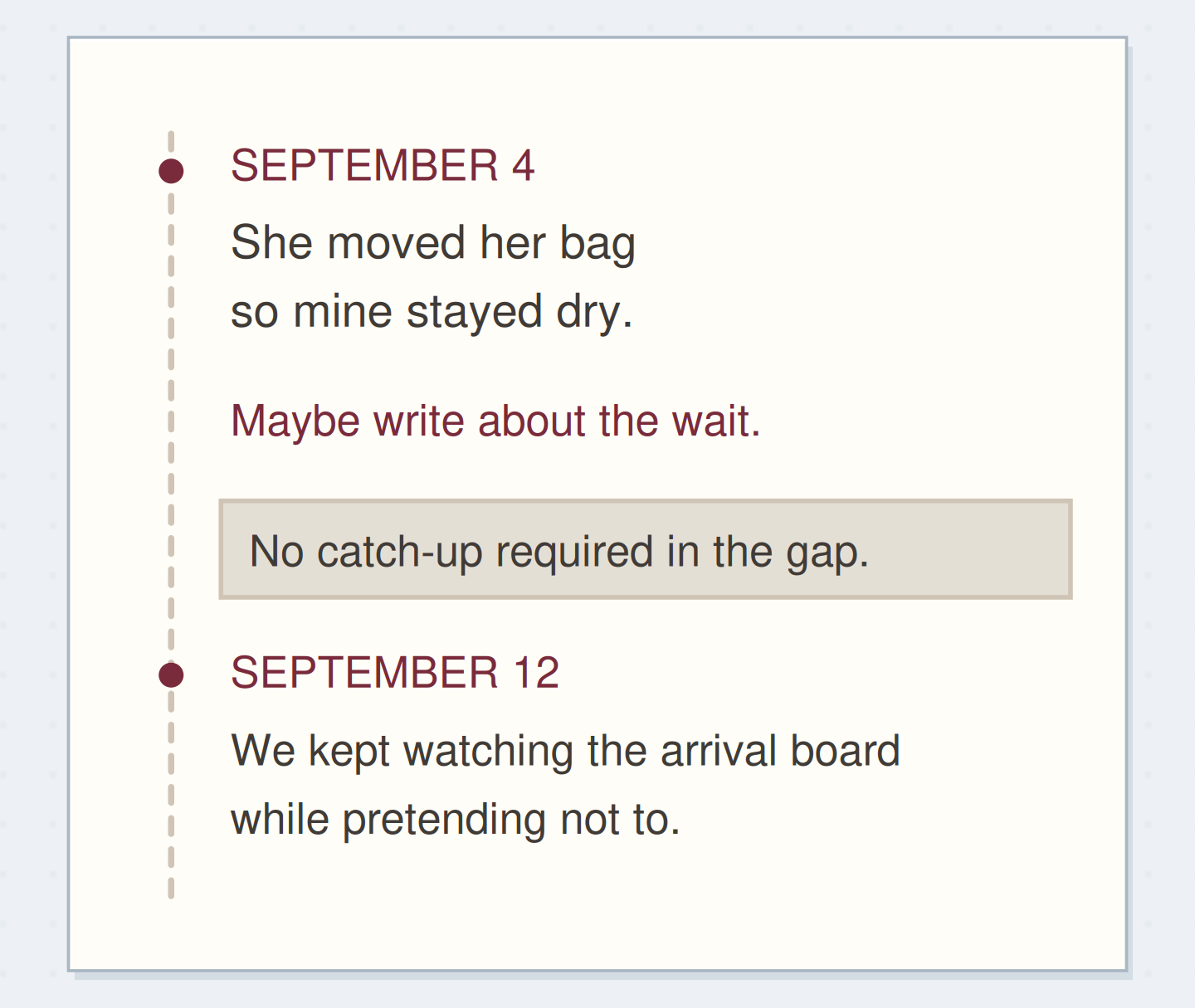
September 4: “Rain blowing under the station roof. The woman beside me moved her bag so mine could stay dry. I want to keep that small act. Maybe write about the wait.” September 12: “The wait: I remember how we both pretended we weren’t watching the arrival board every few seconds.”
The first entry is complete as a small observation. Its last line offers a starting point without promising a longer version. The second entry follows it eight days later because the writer still wants to. There are no blank daily boxes to fill between them and no requirement to explain the interval.
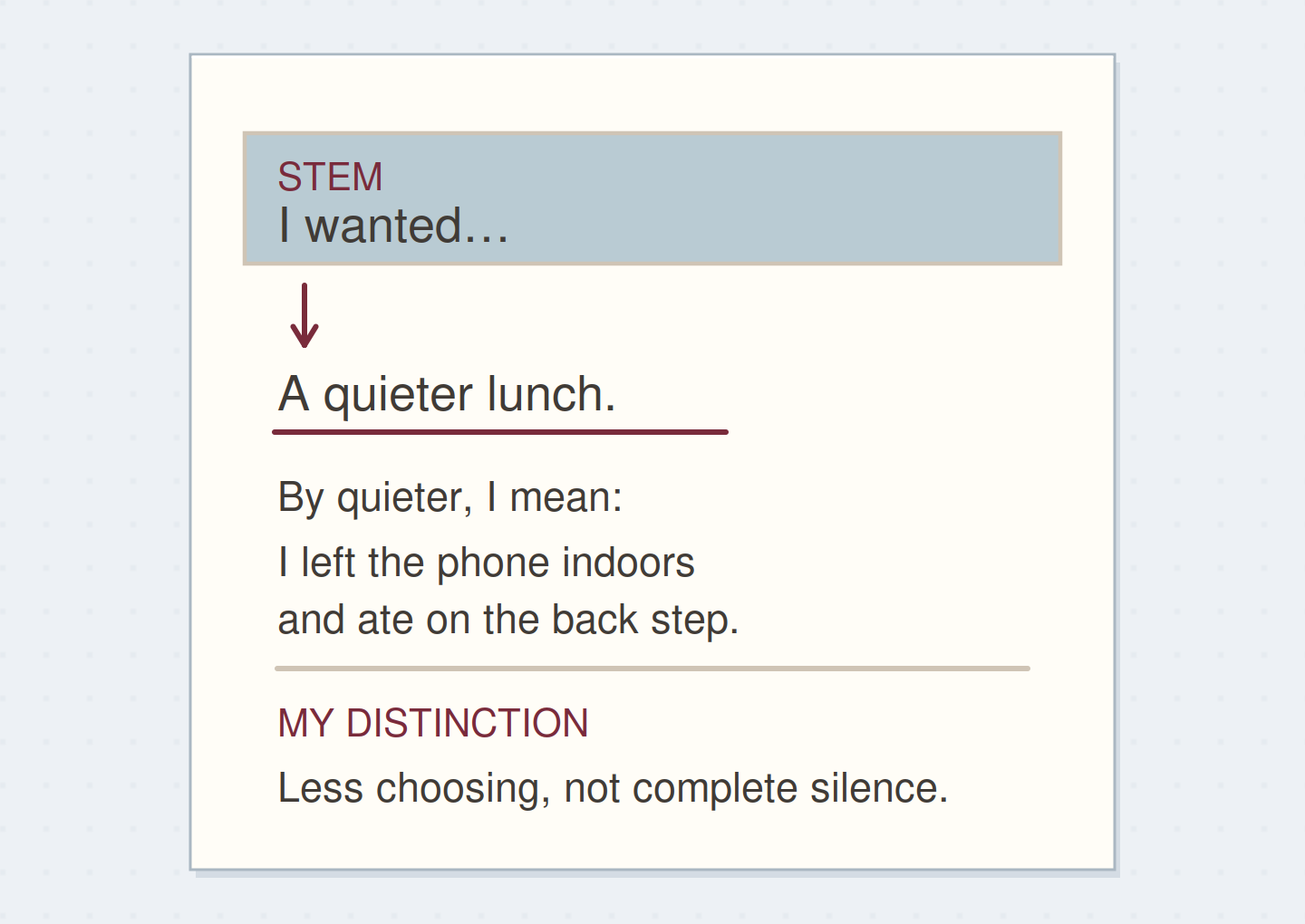
Turn a writing obligation into a useful cue
A cue names a subject while leaving you free to choose.
Starting version
The note creates a task without a clear starting point.
When even the small version feels like too much
Close the notebook without adding a marker if that is what you want. An empty space doesn’t need a decorative substitute, a streak symbol or a sentence proving that you tried. You can also leave a loose bookmark at the next available page so returning involves fewer decisions.
If handwriting feels physically awkward, use another comfortable way to capture a few words or skip the entry. The point is not to force a particular tool. Avoid making the rescue more elaborate than the writing: a complicated menu of emergency formats can become another thing to manage on the days this approach is meant to accommodate.
Leave a cue that invites rather than assigns
A useful reentry cue names something concrete: “the wait at the station,” “the sentence about the blue bowl,” or “ask what changed after lunch.” Keep it short enough that you can understand it at a glance. “Write more” gives you a duty without giving you a subject.
Use tentative wording if that fits: “Possible next entry…” or “If I return to this…” You can ignore a cue whose interest has passed. A cue is a doorway, not an unfinished task. The notebook remains available when you’re allowed to begin somewhere else instead of clearing the previous page’s invitation first.
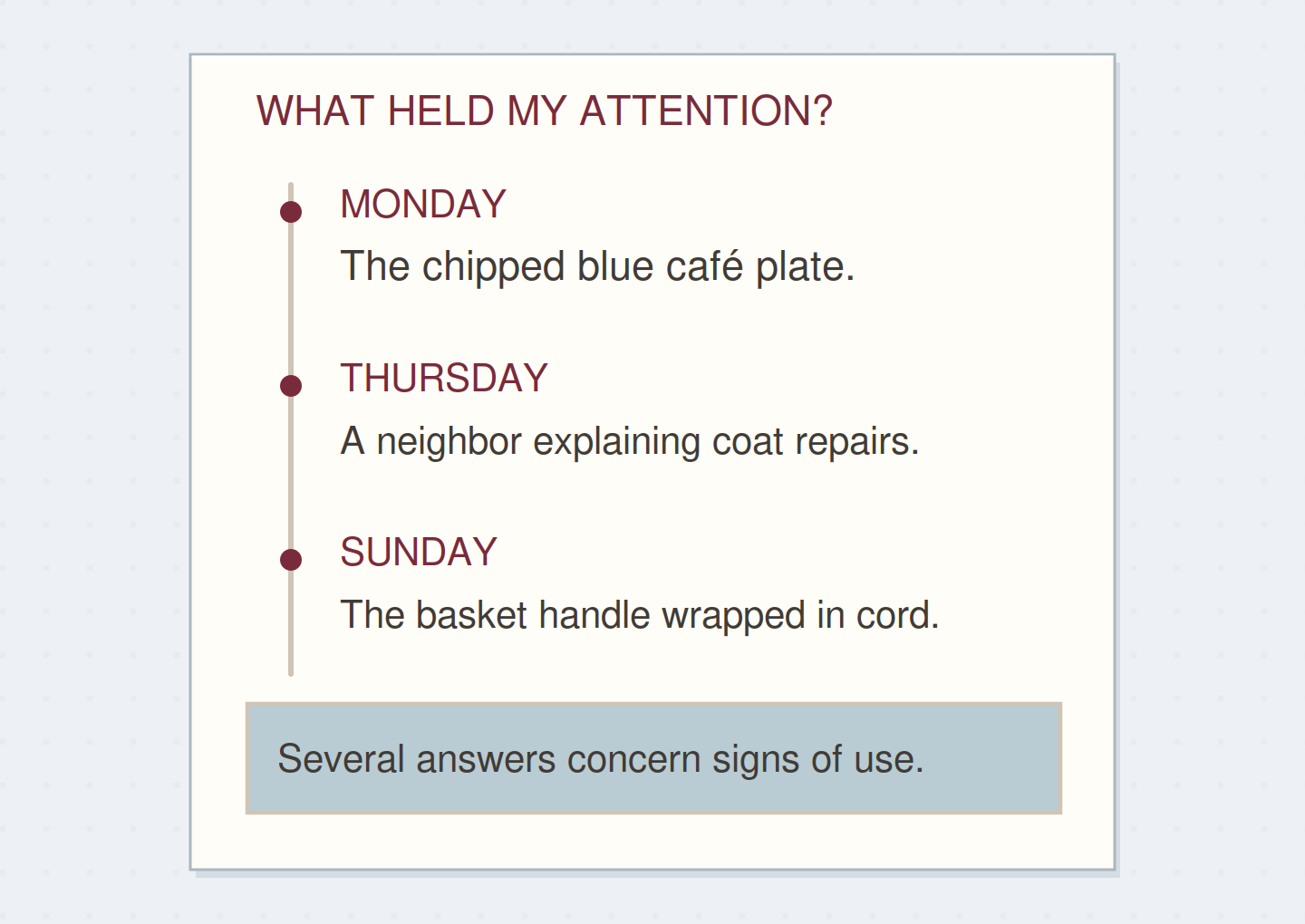
Choose the form available today
These are alternatives, not levels of achievement.
A few concrete phrases can be the entry.
No paragraph is owed afterward.
Let the next entry be its own size
When you return, choose the amount again. You might follow the cue, write a new observation or fill several pages. Don’t require a long entry to compensate for a short one, and don’t preserve a tiny format after it stops fitting. Continuity can include changing the method.
A small entry does not create a writing debt. Stop when you’ve recorded the detail you wanted, or when writing no longer fits the moment. The next date can sit beside it whenever it arrives. The finished record will show the writing you actually made, with room for both brief visits and longer conversations with the page.
Where this idea began
Want to follow the idea further? These community discussions and maker references are a good place to start.
- Breaking out of the “Sorry I haven’t written in a while!” mentality
The opening post describes apology entries becoming exhausting; replies discuss resuming in the present and changing the form of an entry.
- Make journaling easy?
The author describes feeling tired or overthinking before beginning, while a few sentences addressed like a note feel more natural.
- Brainstorming Techniques — George Mason University Writing Center
Describes timed, unedited writing followed by considering the scope and possible focus of the material generated.