Gather a few things See what you’ll need
- Notebook
- Pen
- One source you can revisit
- Bookmark
Choose an entry with a job
Pick something you can imagine using or enjoying again. Perhaps a workshop handout explains a test you want to try, or a paragraph raises a question that connects to your own work. You do not need to collect the whole chapter because one part interested you.
Write a short reason in your own words: “useful when choosing caption size” or “a phrase I want to think about.” That reason can change later. Its immediate job is to make this entry more than an isolated copied fragment. An ordinary notebook is enough; a built-in index or special page ruling is optional.
Follow one collected idea
Which version of the practice entry do you want to inspect?
The words have lost their voices.
It is unclear which sentence came from the source.
Make the source and your response distinguishable
Put the source name near the entry while the original is still open. You can record it before or after the fragment. If you copy an exact sentence, use quotation marks and preserve the wording. If you summarize, label it “summary” or write clearly in your own voice. Begin your response with “My note” or another plain label that you can repeat.
You do not need a color for each kind of text. A small gap and a label are enough. A community commonplace example uses margins for definitions and personal responses; that is one useful arrangement, but your main writing area can hold the same distinctions without a narrow sidebar.
Keep your response beside the source
Edit the worked example into a note you can use.
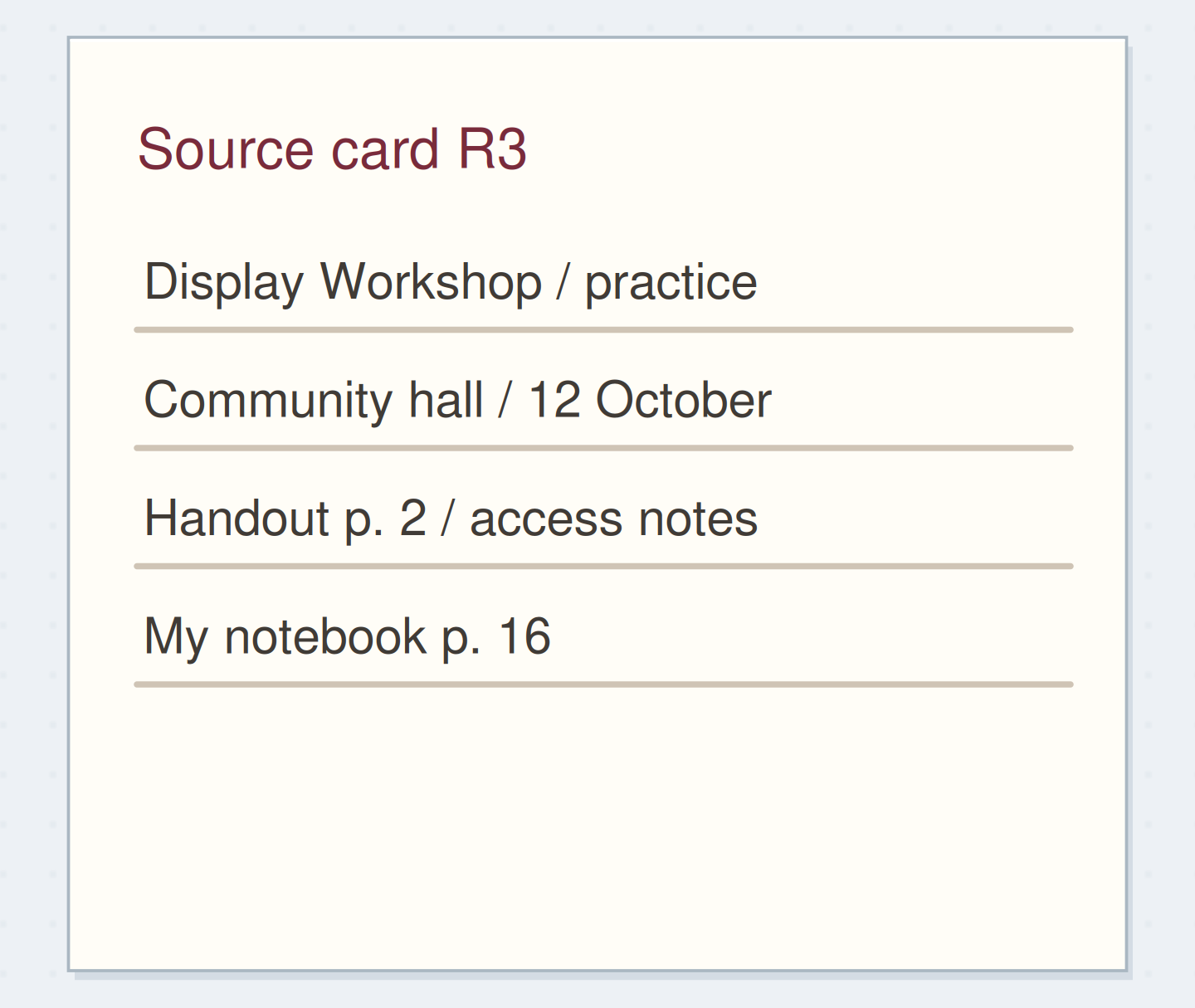
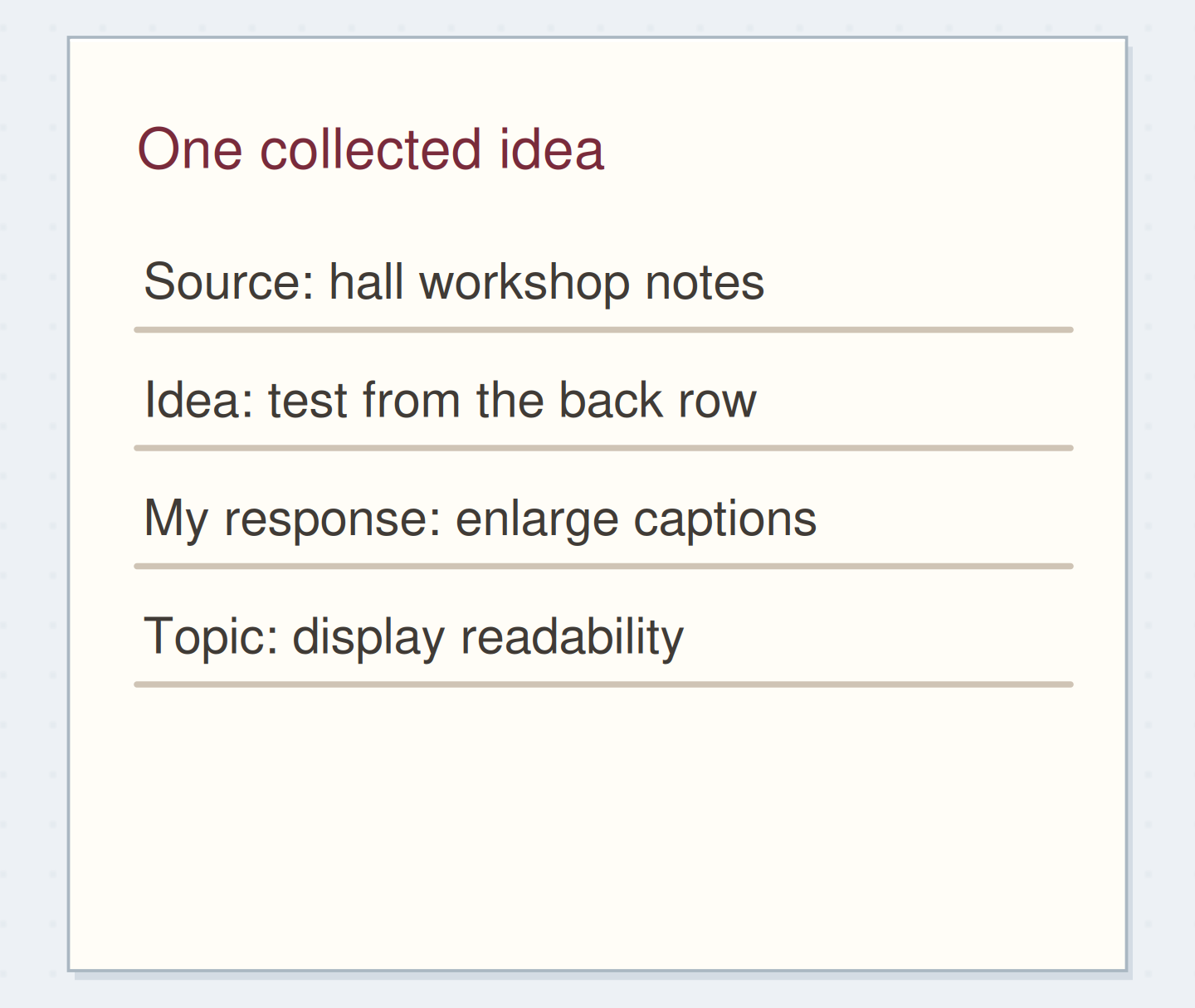
Source:Practice handout: Display Workshop, p. 2
Collected idea:Test a caption from the back row
My response:Enlarge my sample before testing
Your words have a place now.
Replace the invented source with a real one before using this as your own reference entry.
- Words on this card
- 23
“For today, stop when one entry has identifiable voices, a source trail, and a route back to it.”
Leave enough space for the part you will add
Try an entry with a short heading, two lines of source information, a small content block, and a response below. In an A5 notebook, half a page may be comfortable for this example. That is a starting shape, not a quota. A long passage or diagram can use more space when you choose to keep it.
Leave a blank line after the entry so a later thought can be added without merging into the original text. Number the page. If you expect to return to the topic, add one index entry after you have written the content rather than allocating sections for every possible future interest.
Build an original practice entry
Use the invented handout “Community Hall Display Workshop, page 2.” Its practice idea is “test a caption from the back row.” Summarize that idea in your own words, then add: “My note: enlarge the sample caption before testing.” Give the entry the heading “Display readability.”
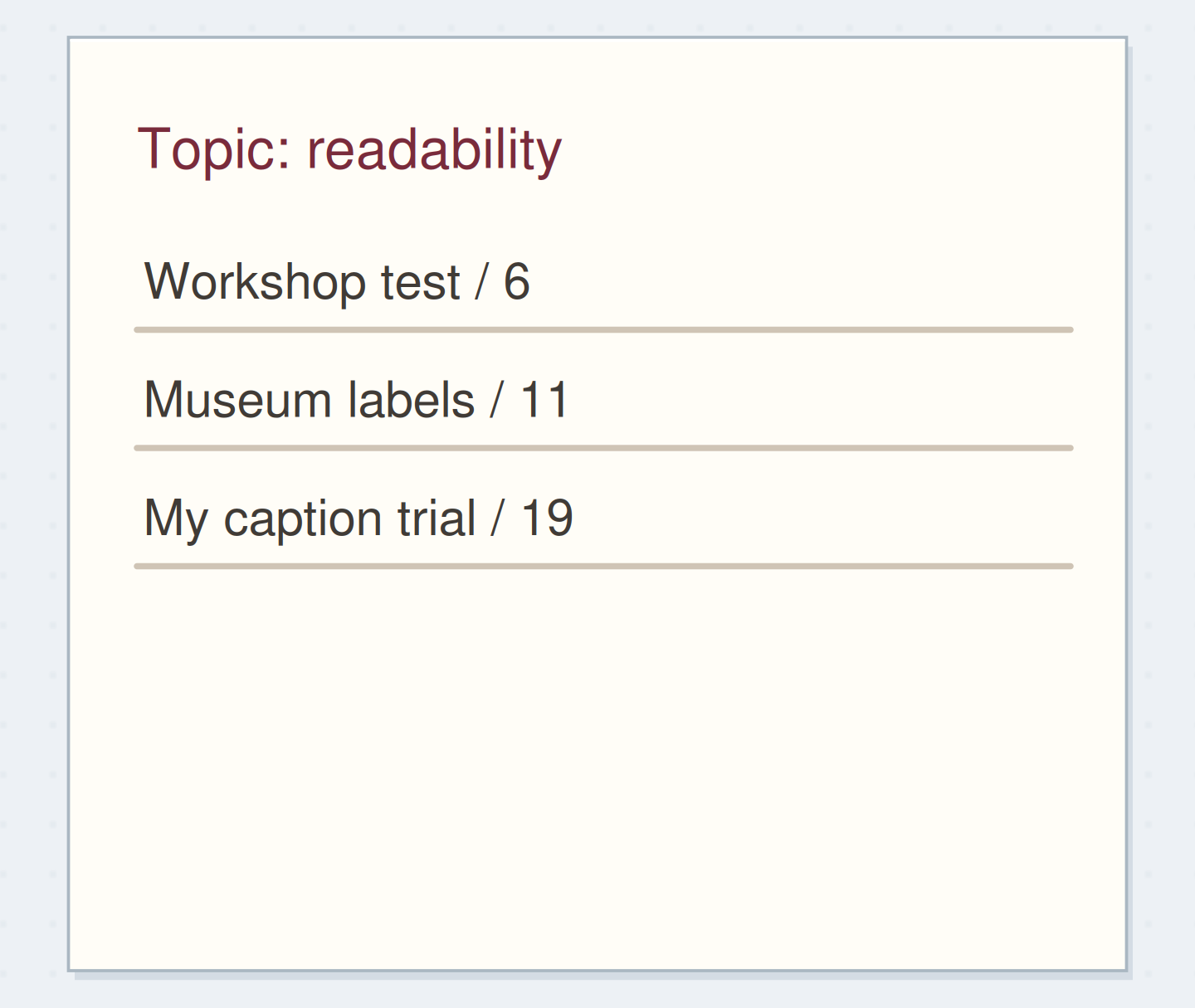
The source line explains where the idea is supposed to come from within the exercise. The response shows what you might do with it. Add “Display readability: p. 6” to the index. If you later use a real handout, replace the invented source with its actual title, author or organization, date, and page.
Keep uncertainty visible
If an old entry has no source, do not confidently assign it to the author you vaguely remember. Write “source not yet found” and keep your recollection separate, such as “possibly from the hall workshop.” If finding the source matters, create a small search task and stop treating the fragment as a verified quotation.
You can still record why the idea interests you. Alternatively, rewrite it as your own present observation without claiming that the wording originated with you. The aim is an honest distinction between what you know, what you copied, and what you are still trying to trace.
Show uncertainty honestly
Move the reveal control to inspect the specific change.
A guessed attribution
A confident-looking source line can hide uncertainty.
Use the collection before enlarging the system
A week later, imagine you are choosing caption size. Open the topic index, find page 6, and read your own response alongside the collected idea. Add the result of your trial: “The smaller sample was hard to read from the doorway; try the larger version.” This is a new observation, so date it.
That return visit may create a useful connection to another page. Add “caption trial p. 19” if it helps. Avoid making a link merely because both entries contain the word “display.” The relationship should tell you something: a test, an example, a disagreement, or a question worth pursuing.
Let the first few entries shape the book
After several entries, notice what you actually keep. If your subjects range widely, a topic index may help. If you mostly take notes from one source at a time, a source list may be enough. You can add either later without abandoning the pages you already used.
For today, stop when one entry has identifiable voices, a source trail, and a route back to it. Your commonplace book does not need to look complete before it can contain something worth keeping.
Finish one findable entry
Move the steps so the necessary checks happen before the actions that depend on them.
One workable order
- Record the source while it is openThe source can be recorded before or after the fragment while the original remains available.
- Write the fragment and your responseYou need the actual entry before choosing its index wording.
- Add a retrieval cueThe cue should point to the content you really wrote.
Which check needs to come first?
The example shows one workable order. Other steps can move freely; these checks protect the information you need.
Where this idea began
Want to follow the idea further? These community discussions and maker references are a good place to start.
- My First Commonplace Book: Complete
A notebook keeper describes using margins for source information, definitions, and personal responses.
- How to Turn Any Notebook into a Commonplace Book
The maker tutorial presents commonplace entries and several ways to retrieve them in an ordinary notebook.