Gather a few things See what you’ll need
- Notebook
- Pen
- The day’s notes or calendar
Decide what you want the record to explain
A done list might help you recall a busy day, prepare a project update, or understand why a planned task stayed untouched. Choose one of those uses before adding detail. A personal memory record can include a small household repair; a project update may need only the work connected to that project.
Community notebook discussions include people using done lists when forward task lists did not describe their actual work well. That is a reported use, not a promise of any particular effect. You can try the record for a few days and keep it only if it answers a question you care about.
Watch a factual done record take shape
Which version best answers what happened?
Unplanned work can still be recorded.
The list names three finished changes rather than a vague category.
Use words that identify a finished change
Write what changed: “sent room answers,” “repaired folder hinge,” or “labelled storage boxes.” “Admin” is too broad if you later want to remember what the administration involved. At the same time, avoid splitting one familiar action into five tiny lines merely to make the page look fuller.
If you worked on something without finishing it, record that honestly: “edited the first two pages of the zine.” That can be a completed work segment even while the project remains open. Make the boundary visible so the note does not later look like a claim that the whole project was finished.
Describe partial project work accurately
Move the reveal control to inspect the specific change.
An overstated finish
A project title can overstate what a session achieved.
“Stop after the selected actions are recognizable and any new commitment has a home.”
Choose context that will matter later
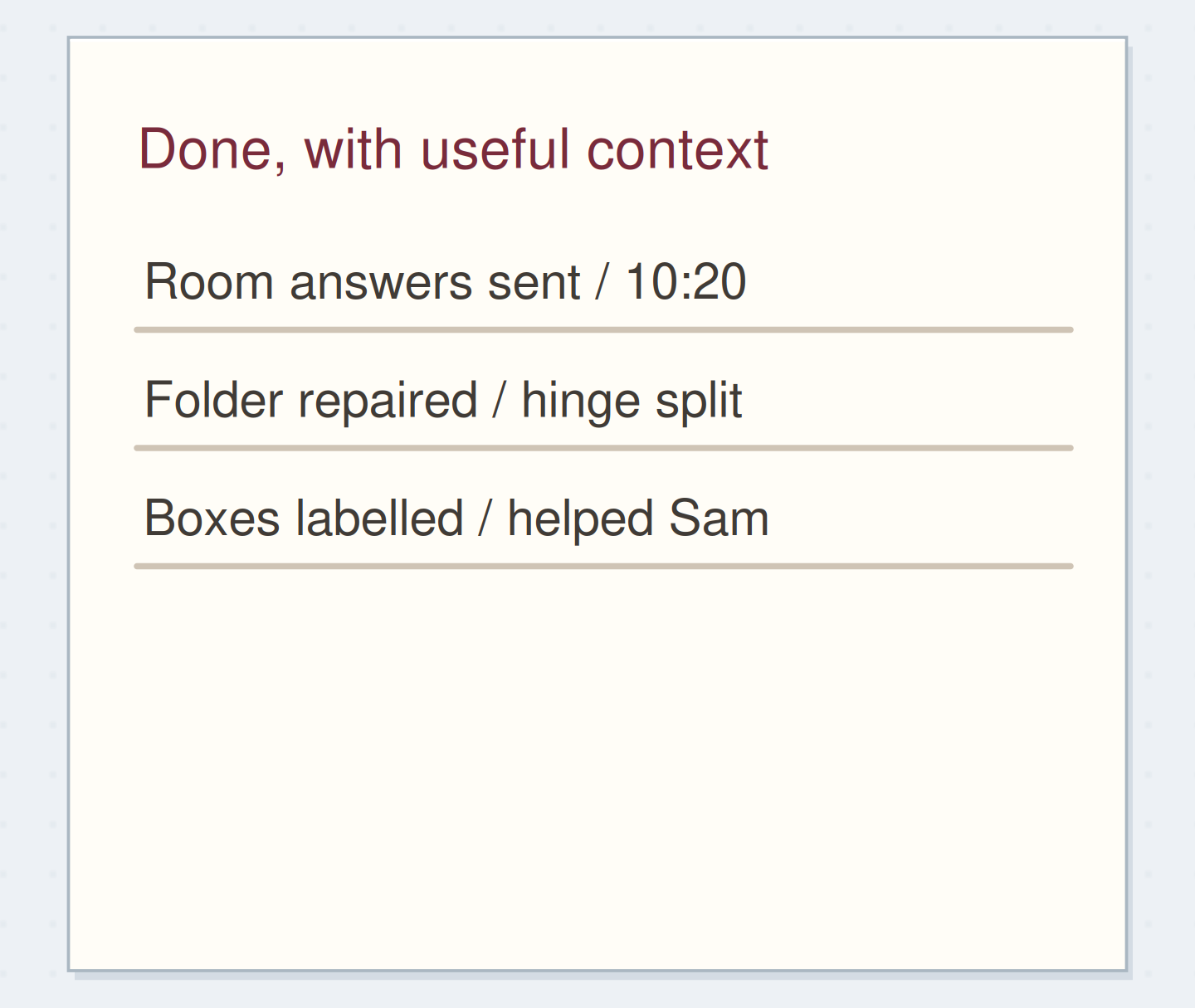
Add a time, result, person, or page reference only when it makes the line more useful. “Room answers sent, 10:20” might help you distinguish the reply from yesterday's draft. “Folder repaired: hinge split” explains what the repair addressed. “Helped Sam label boxes” records that the work was shared.
You do not need all four kinds of context on every line. A compact record stays readable because each added detail earns its place. If the story needs a paragraph, write a daily note and let the done list point to it. The list can be an entry point without containing the entire account.
Make one completed action recognizable
Edit the worked example into a note you can use.
Completed action:Repaired the draft folder
Useful context:The hinge had split
Optional reference:Zine project
Your words have a place now.
Add only details that help you understand the entry later.
- Words on this card
- 16
Work through a realistic three-line record
Imagine you planned to print a zine sample, but three other things happened first. You answered the hall's questions about the reading group, repaired the folder holding your drafts, and helped label storage boxes. Write those three completed actions under the date. Add only the details you want to retain: the sent time, the repaired hinge, and the person you helped.
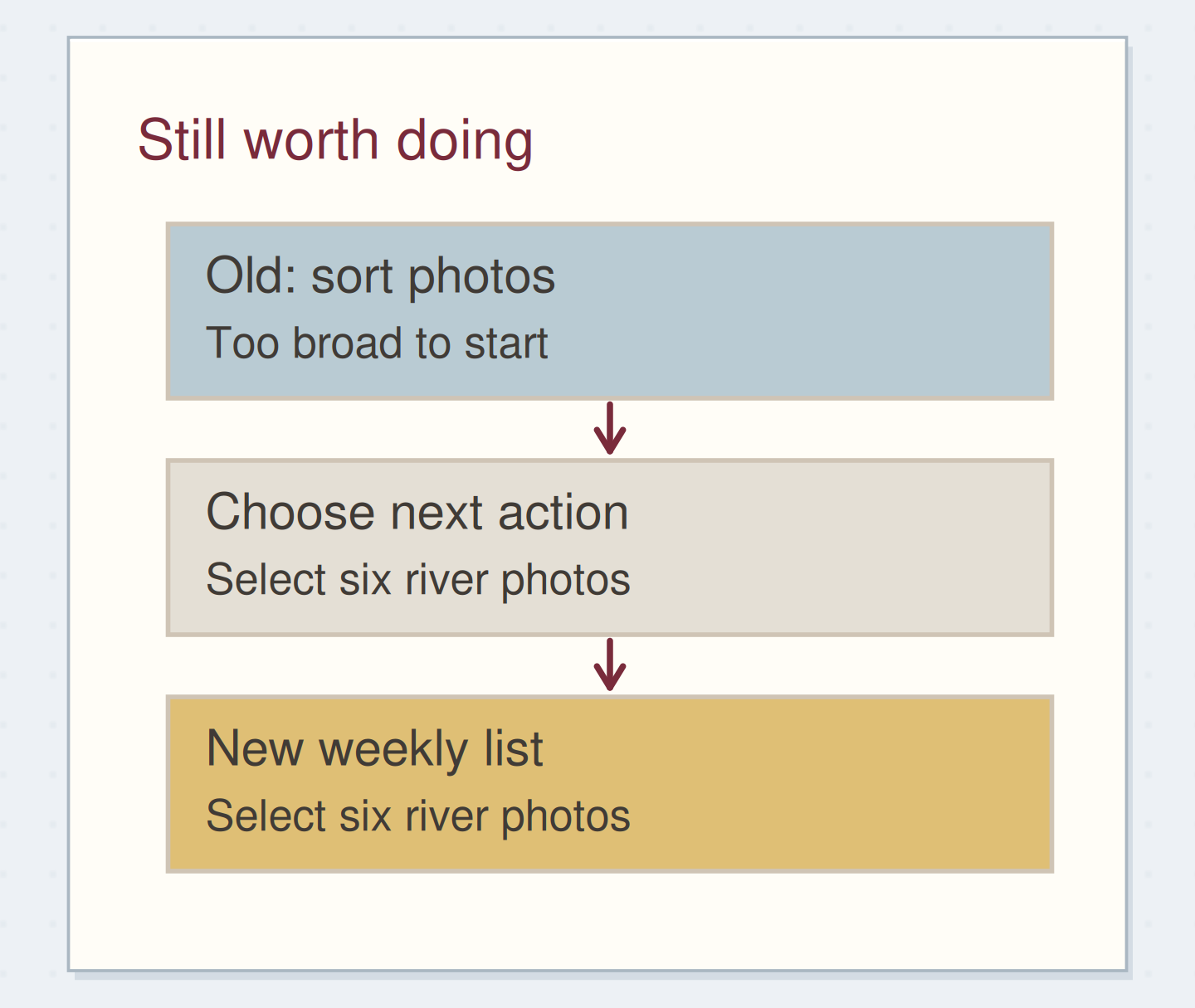
Leave “print zine sample” open on its live task list. The done record explains part of the afternoon, but it does not automatically cancel the printing task. At review, decide whether printing still belongs tomorrow, needs a smaller next step, or should move to another planning period.
Keep unlike kinds of work from becoming a tally
Five short errands and one long draft are not equivalent units. A simple count of completed lines can hide that difference. If your purpose is understanding the day, the words and context are usually more informative than a total at the bottom.
You can group related work under a heading such as “Reading group preparation” without assigning points. You can also include maintenance and assistance when they matter to the account. The record should describe the work you chose to notice, not imply that anything unrecorded was worthless or that every hour has to justify itself on paper.
Choose information over a line count
Move the reveal control to inspect the specific change.
A total without context
Different actions are not equal units of effort or importance.
Use existing evidence without inventing a full timeline
If you make the list later, look at the calendar, sent messages, or a few notebook pages for prompts. Record only what you can reasonably identify. “Probably answered emails” is less useful than “sent room answers” when you can see the actual message. If the detail is uncertain, say so or leave it out.
Do not spend more time reconstructing the day than the record is worth to you. One clear completed action is a valid entry. You can leave a date blank or write a short ordinary observation instead. A missing record does not need to become another unfinished task to carry into next week.
Close the record without adding another planning system
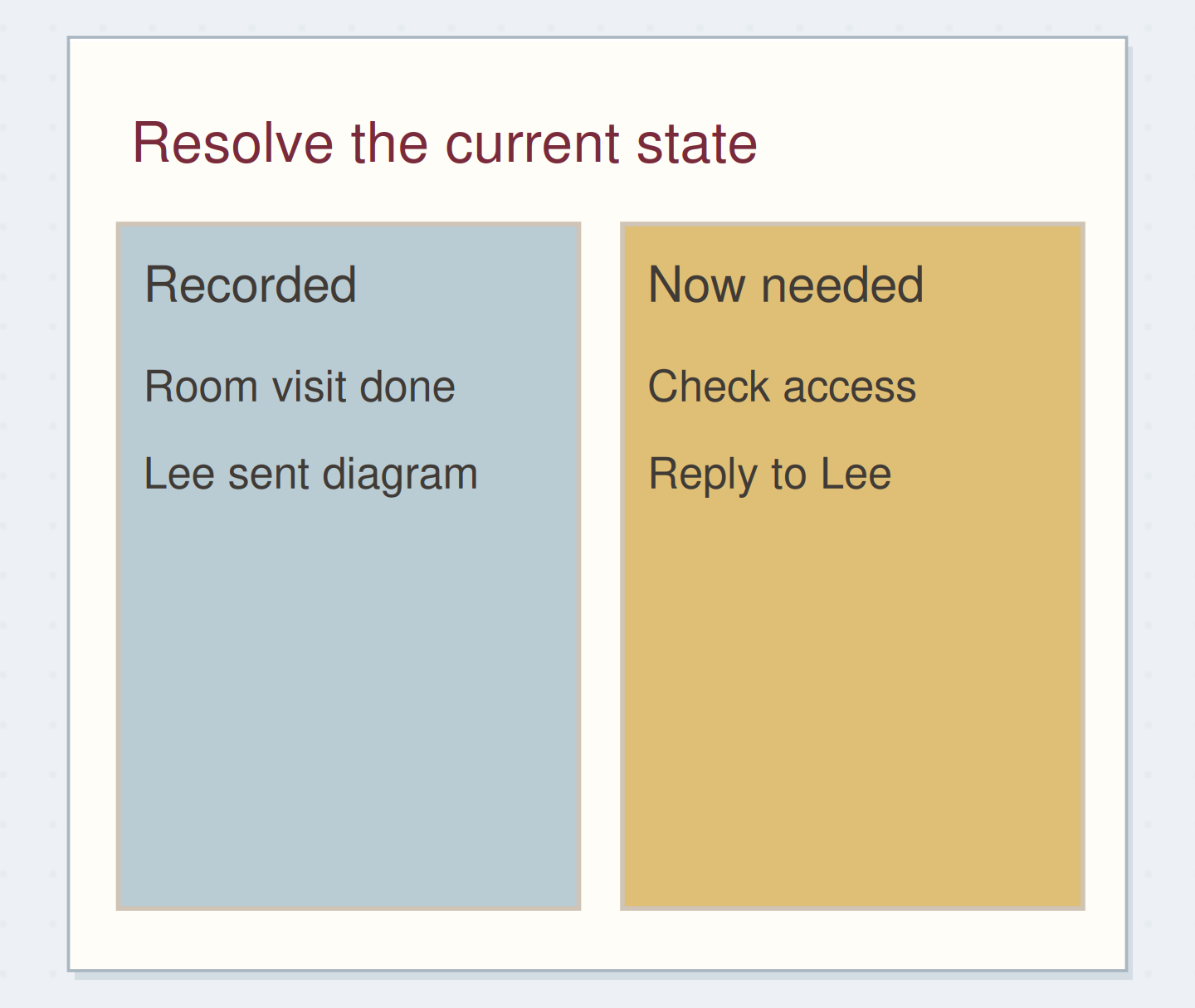
Read the completed lines once and notice whether any result creates a new obligation. Sending the room answers may leave “confirm key pickup” as a separate next action. Put that in the existing action pool. Do not build a second complete to-do list beneath the done record unless that is already your normal planning place.
Stop after the selected actions are recognizable and any new commitment has a home. Your done list is finished when it tells the truth about the work you chose to record.
Where this idea began
Want to follow the idea further? These community discussions and maker references are a good place to start.
- When Project Plans Live Elsewhere
A participant describes using a done list when an ambitious forward task list was hard to maintain.
- A Weekly Log to the Ryder Carroll System
A practitioner describes using a weekly review to connect project outcomes, next actions, and leftover daily notes.