Gather a few things See what you’ll need
- Notebook
- Pen
- Clock or timer
- One repeatable ordinary task
Measure a task you can recognize again
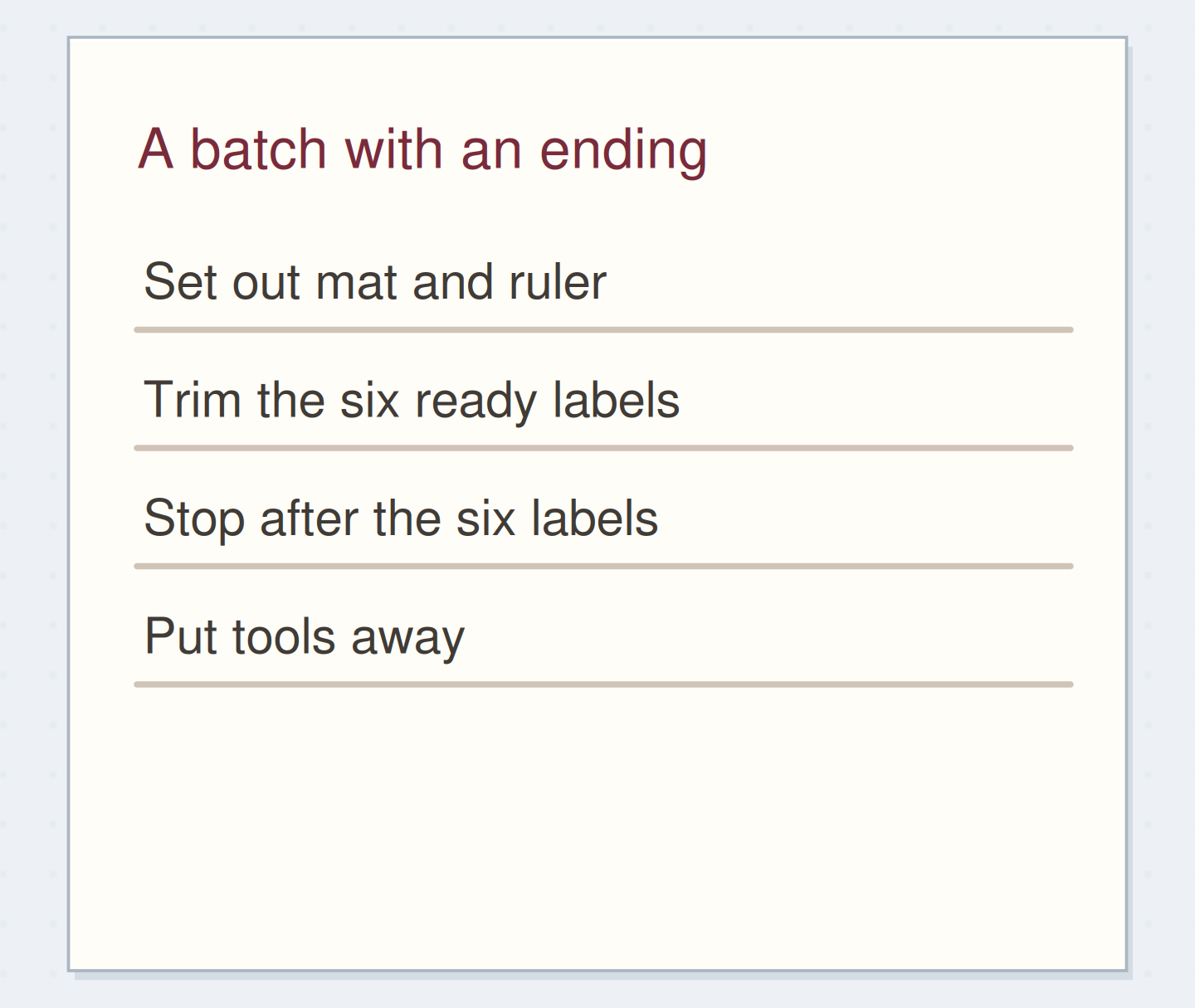
Choose an ordinary repeatable task with a visible beginning and ending, such as trimming six approved labels of the same width. “Work on display” is too broad for a useful comparison because it could include planning, printing, cutting, and travel. Describe the output and relevant conditions.
Record whether setup and cleanup are included. For this trial, the work begins when you gather the cutting tools and ends when the six labels are trimmed and the tools are returned. A future comparison should use the same boundary or explicitly note the difference. Precision in the definition matters more than recording seconds.
Compare prediction, observation, and reuse
Which stage of the estimate would you like to inspect?
The work boundary is defined before the trial.
Setup and cleanup are included in the 15–20-minute estimate.
Use a range when that matches your uncertainty
Before starting, write your estimate: “15–20 minutes, including setup and cleanup.” If it is a guess, label it as a first guess. Do not edit the original prediction after seeing the result. You need both values to understand what changed.
Choose the level of detail that serves your planning question. A rough five-minute range may be enough for deciding whether the task fits before an appointment. There is little value in recording a highly precise number when the next batch may have different materials or an uncertain interruption. Keep the estimate appropriately provisional.
Make an estimate you can compare
Edit the worked example into a note you can use.
Work unit:Trim six labels of one width
Boundary:Gather tools through returning them
Prediction:15–20 minutes of active work
Your words have a place now.
Preserve this prediction before starting; revise a separate future estimate afterward.
- Words on this card
- 20
“Stop collecting when the estimate is good enough for the choice you need to make.”
Decide which kind of time you are comparing
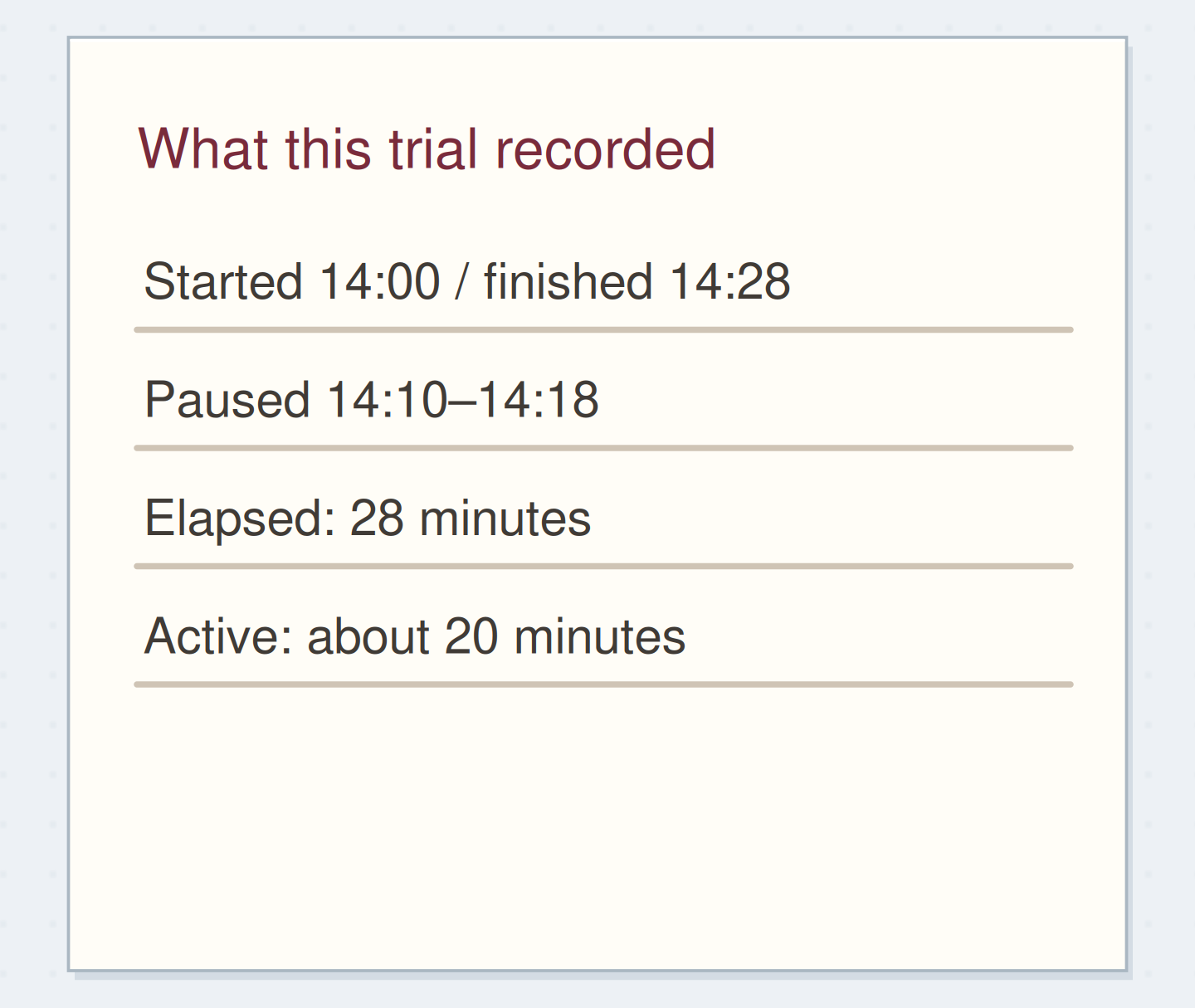
Write a start and finish time. If a substantial interruption occurs, note its approximate beginning and ending. Elapsed time is the clock interval from start to finish. Active time, for this simple record, is elapsed time minus the pauses you recorded; it is still an approximation.
Do not silently compare an estimate of active work with an elapsed interval that includes a long conversation. Both numbers can be useful, but they answer different questions. Active time helps describe the work itself, while elapsed time describes how much of that actual afternoon the session occupied.
Keep the arithmetic attached to the circumstances
Imagine you start at 14:00 and finish at 14:28. You pause from 14:10 until 14:18 to answer an unrelated question. The elapsed interval is 28 minutes. The recorded pause is 8 minutes, leaving about 20 minutes of active work under this trial's definition.
Your original 15–20-minute prediction included setup and cleanup, so the active result falls at its upper end. The whole session still occupied 28 minutes on the clock. Record both facts instead of choosing whichever number makes the prediction look better. If interruption time is uncertain, use an approximate result and say so.
Distinguish elapsed time from active time
Move the reveal control to inspect the specific change.
The whole clock interval
Elapsed time answers how much clock space the session occupied.
Carry forward the relevant conditions
For another batch of six labels with the same tools and width, “about 20 minutes of work” is a reasonable provisional note from this single trial. It is not a rule for every cutting task. A different label size, missing materials, or a larger quantity may change the work enough that you need a fresh estimate.
When you place the work before a fixed appointment, consider the clock space actually available rather than assuming no interruptions will occur. You can choose additional room based on your situation without pretending this one observation proves a standard buffer. Keep the distinction between observed work time and the space you decide to reserve.
Remove details that do not change a decision
If recording every pause disrupts the task, simplify. Note only start, finish, and one brief explanation of a major interruption. If your question is merely whether the task usually takes ten minutes or an hour, that may be sufficient. Leave uncertain figures approximate rather than reconstructing a minute-by-minute history afterward.
If the task is not likely to recur, you may not need another trial. Keep one observation where it helps a related project and move on. The point is to improve a practical prediction, not to maintain a complete account of how every minute was used.
Use the record for a real planning choice
Compare another trial only if a concrete uncertainty remains: perhaps setup varied because the tools were stored elsewhere. Revise the working range when the new conditions justify it. Keep the original observations readable so the estimate does not become a number detached from its evidence.
Stop collecting when the estimate is good enough for the choice you need to make. A useful time note names the work, the conditions, and the uncertainty that remains.
Keep the estimate review interpretable
Move the steps so the necessary checks happen before the actions that depend on them.
One workable order
- Write the task boundary and predictionThe original prediction must exist before the result is known.
- Record what happened under that boundaryKeep circumstances and substantial pauses with the times.
- Revise a separate estimate for similar workThe revision depends on the actual observation, not a rewritten prediction.
Which check needs to come first?
The example shows one workable order. Other steps can move freely; these checks protect the information you need.
Where this idea began
Want to follow the idea further? These community discussions and maker references are a good place to start.
- Tracking Time Quickly and Efficiently
The contributor records rough durations for repeated tasks and stops collecting once the estimate is useful.
- Getting Things Done with the Bullet Journal Method
A discussion includes estimating preparation time and distinguishing project time from other work.